Era IX · 1989–2008

The Bush Era and Post–Cold War Republicanism

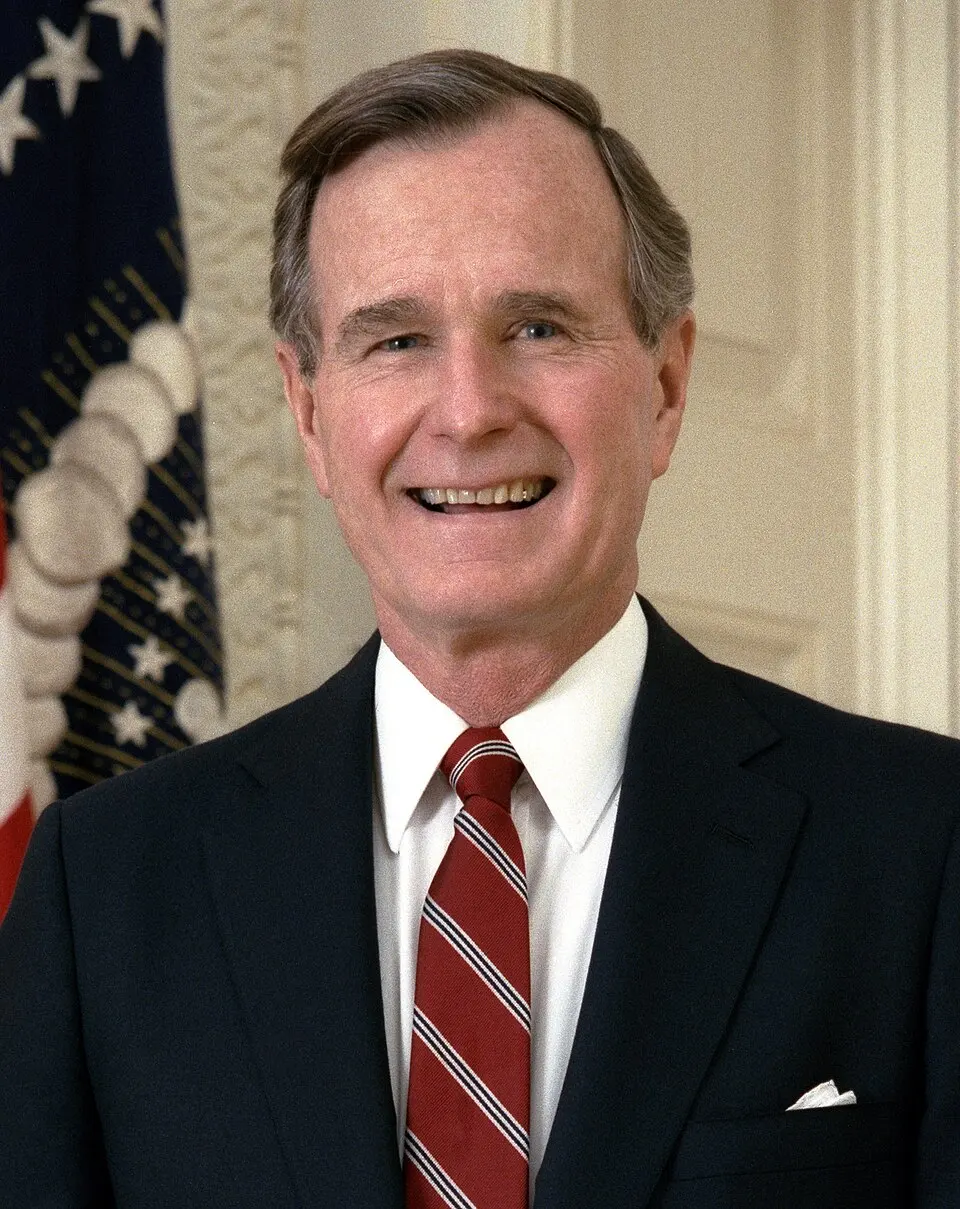
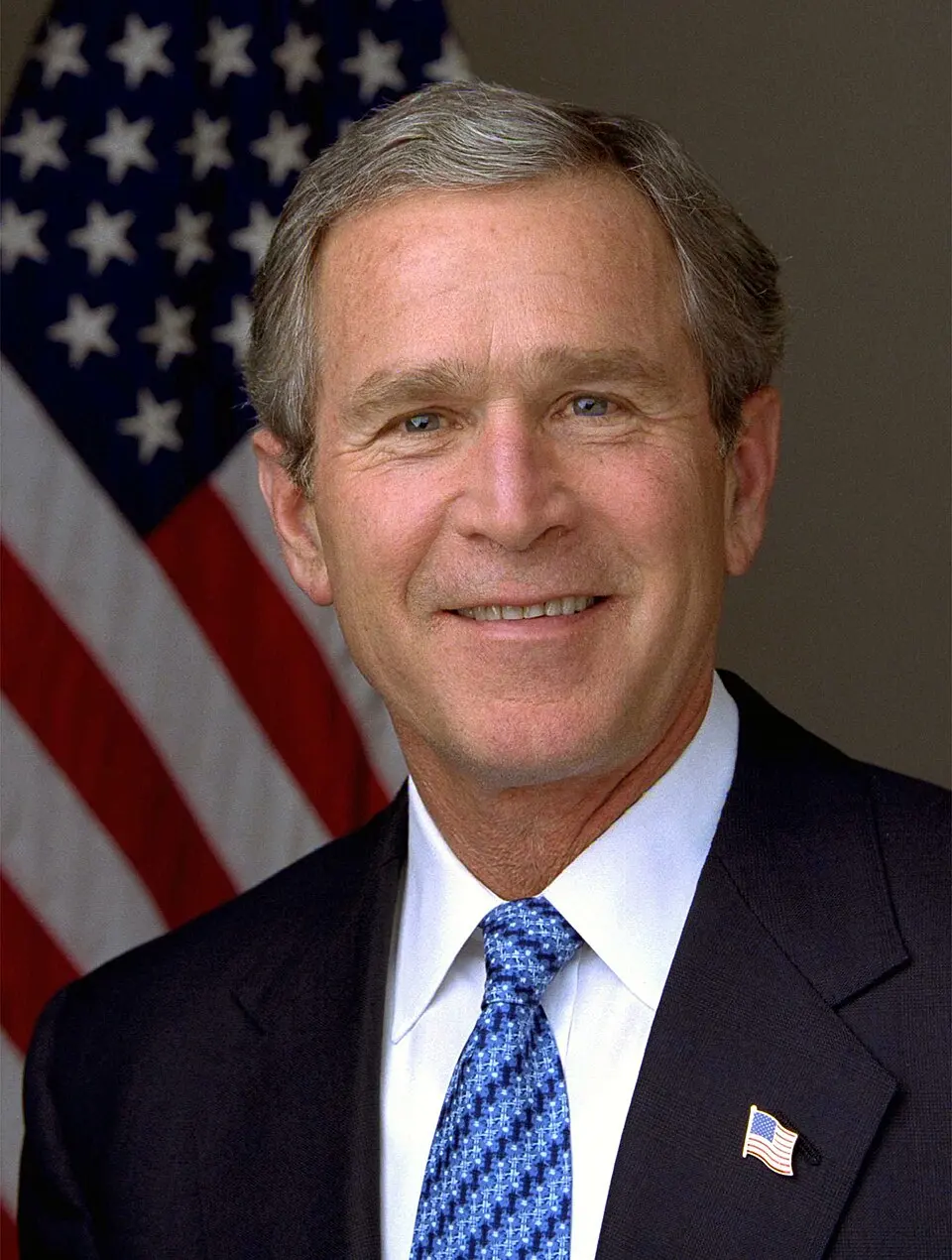
Two Presidents Bush, and the Republican Congress elected in between, carried Reagan’s party through the end of the Cold War, the September 11 attacks and two wars—and into arguments over spending, war and bailouts that would reshape it.

Overview

The Republican presidents of the post–Cold War era inherited Reagan’s coalition and faced problems it had not been built for. George H. W. Bush, elected in 1988 as Reagan’s heir, presided over the fall of the Berlin Wall in November 1989, the reunification of Germany within NATO in October 1990 and the dissolution of the Soviet Union in December 1991—outcomes managed through careful diplomacy rather than triumphalism. When Iraq invaded Kuwait in August 1990, Bush assembled a coalition backed by the United Nations and won congressional authorization, and Operation Desert Storm liberated Kuwait in six weeks of air and ground combat in early 1991.

At home Bush signed the Americans with Disabilities Act and the Clean Air Act Amendments of 1990, and in 1990 he broke his 1988 “no new taxes” pledge in a budget agreement with the Democratic Congress, angering many conservatives. A recession, a primary challenge from Patrick Buchanan and Ross Perot’s independent candidacy contributed to his defeat by Bill Clinton in 1992. Two years later House Republicans led by Newt Gingrich campaigned on the Contract with America and won the House for the first time in 40 years, along with the Senate. The Republican Congress and Clinton fought through two government shutdowns, then reached compromises on welfare reform and a balanced-budget agreement that, with strong growth, produced the first federal surpluses since 1969. The House impeached Clinton in December 1998; the Senate acquitted him in February 1999.

George W. Bush won the presidency in 2000 after a 36-day Florida recount ended in Bush v. Gore, while losing the national popular vote. He campaigned as a “compassionate conservative” and, with bipartisan support, signed the No Child Left Behind Act. The attacks of September 11, 2001, which killed nearly 3,000 people, transformed his presidency: the United States went to war in Afghanistan, created the Department of Homeland Security, expanded surveillance and intelligence powers, and in March 2003 invaded Iraq to remove Saddam Hussein, citing weapons-of-mass-destruction programs whose stockpiles were never found. Bush also signed tax cuts in 2001 and 2003, a Medicare prescription-drug benefit and PEPFAR, a global AIDS-relief program credited with saving millions of lives.

Bush’s second term was dominated by Iraq. Sectarian violence worsened until the 2007 troop “surge” under General David Petraeus reduced it; the federal response to Hurricane Katrina drew criticism from both parties; and Democrats won both houses of Congress in 2006. In 2008 the collapse of the housing market became a global financial crisis, and Bush and Treasury Secretary Henry Paulson won passage of the $700 billion Troubled Asset Relief Program over the opposition of most House Republicans. Senator John McCain lost the presidency to Barack Obama that fall. The era left the party a record of national-security leadership and conservative judicial appointments—Chief Justice John Roberts and Justice Samuel Alito—along with internal disputes over spending, war and bailouts that fed the Tea Party movement.

Timeline

  1. The Berlin Wall falls

    East German authorities open the border crossings, and Berliners begin tearing down the wall that had divided their city since 1961. Bush responded with deliberate restraint, avoiding any display of triumph that might provoke a Soviet backlash.

    Historical Record
  2. Bush signs the Americans with Disabilities Act

    Passed with broad bipartisan majorities, the ADA prohibits discrimination on the basis of disability in employment, public services, public accommodations and telecommunications—the broadest expansion of the nation’s civil rights laws since 1964.

    Primary Source
  3. Germany is reunified

    Less than a year after the Wall fell, East and West Germany unite under the “Two Plus Four” treaty negotiated by the two German states and the four World War II Allied powers. Bush strongly supported a united Germany within NATO when British, French and Soviet leaders hesitated.

    Historical Record
  4. Operation Desert Storm begins

    Five days after Congress authorized force—52–47 in the Senate and 250–183 in the House—a U.S.-led coalition opens an air campaign against Iraq. A ground offensive launched on February 24 liberated Kuwait, and offensive operations were suspended on February 28.

    Historical Record
  5. The Contract with America

    On the Capitol steps, more than 300 Republican House candidates pledge to bring ten bills to a vote within the first 100 days of a Republican Congress, from a balanced-budget amendment and welfare reform to tax cuts and term limits.

    Historical Record
  6. Welfare reform becomes law

    After vetoing two earlier versions, President Clinton signs the Personal Responsibility and Work Opportunity Reconciliation Act written by the Republican Congress. It replaces the Aid to Families with Dependent Children entitlement with block grants to the states, adds work requirements and sets a five-year lifetime limit on federally funded cash assistance.

    Primary Source
  7. The House impeaches President Clinton

    Arising from the independent counsel’s investigation of Clinton’s testimony about his relationship with a White House intern, the House approves articles charging perjury before a grand jury (228–206) and obstruction of justice (221–212). On February 12, 1999, the Senate acquitted; neither article won even a simple majority.

    Historical Record
  8. Bush v. Gore

    The Supreme Court halts Florida’s court-ordered manual recount, holding that its varying standards violated equal protection and, by 5–4, that no valid recount could be completed in time. Bush carried Florida by 537 votes and won the Electoral College 271–266 while losing the national popular vote.

    Primary Source
  9. The September 11 attacks

    Al-Qaeda terrorists hijack four airliners, striking the World Trade Center and the Pentagon; passengers on United Flight 93 fight back, and it crashes in Pennsylvania. Nearly 3,000 people are killed in the deadliest foreign attack on American soil.

    Historical Record
  10. Address to a Joint Session of Congress

    Bush names al-Qaeda as responsible, demands that the Taliban hand over its leaders, announces an Office of Homeland Security and declares that the war on terror “will not end until every terrorist group of global reach has been found, stopped and defeated.”

    Primary Source
  11. War in Afghanistan begins

    Acting under the Authorization for Use of Military Force, which passed the Senate 98–0 and the House 420–1, the United States and its allies begin strikes on al-Qaeda and the Taliban. Kabul fell in November, but the war became the longest in American history.

    Historical Record
  12. The invasion of Iraq

    Citing Iraq’s defiance of United Nations resolutions and intelligence assessments of its weapons programs, a U.S.-led coalition invades under the October 2002 congressional authorization (296–133 in the House, 77–23 in the Senate). Baghdad fell on April 9, but no stockpiles of weapons of mass destruction were found.

    Historical Record
  13. Roberts becomes chief justice; Alito follows

    The Senate confirms John G. Roberts Jr., 78–22, as the 17th chief justice. After Harriet Miers withdrew her nomination amid objections from conservatives, Samuel Alito was confirmed 58–42 on January 31, 2006, to succeed Sandra Day O’Connor.

    Historical Record
  14. The surge

    Over the objections of many in both parties, Bush announces he is sending more than 20,000 additional troops to Iraq, most of them to Baghdad, under a new counterinsurgency strategy led by General David Petraeus. Violence declined markedly over the following year.

    Historical Record
  15. District of Columbia v. Heller

    In a 5–4 opinion by Justice Antonin Scalia, the Supreme Court holds that the Second Amendment protects an individual right to keep and bear arms and strikes down the District’s handgun ban.

    Primary Source
  16. Congress creates TARP

    Weeks after the Lehman Brothers bankruptcy, the House passes the Emergency Economic Stabilization Act 263–171 on its second attempt, and Bush signs it the same day. The law authorizes up to $700 billion to stabilize the financial system; most House Republicans voted against it.

    Historical Record

People

  • 41st President of the United States, 1989–1993

  • 43rd President of the United States, 2001–2009

  • Speaker of the House, 1995–1999

    Newt Gingrich

    Architect of the Contract with America and the first Republican House majority in 40 years.

  • Senate Majority Leader, 1985–1987 and 1995–1996; 1996 presidential nominee

    Bob Dole

    A World War II veteran gravely wounded in Italy, he resigned from the Senate in 1996 to campaign full time.

  • Chairman of the Joint Chiefs of Staff, 1989–1993; Secretary of State, 2001–2005

    Colin Powell

    The first Black American to hold either post; he presented the administration’s case on Iraq to the United Nations in 2003.

  • Secretary of Defense, 1989–1993; Vice President, 2001–2009

    Dick Cheney

    An influential advocate of a strong presidency in national security.

  • National Security Adviser, 2001–2005; Secretary of State, 2005–2009

    Condoleezza Rice

    The first Black woman to serve as secretary of state.

  • U.S. Senator from Arizona, 1987–2018; 2008 presidential nominee

    John McCain

    A former prisoner of war in Vietnam and an early advocate of the 2007 surge.

  • Secretary of Housing and Urban Development, 1989–1993; 1996 vice-presidential nominee

    Jack Kemp

    Carried supply-side and anti-poverty ideas such as enterprise zones into the 1990s.

  • Chief Justice of the United States since 2005

    John G. Roberts Jr.

    Appointed by George W. Bush after serving on the U.S. Court of Appeals for the D.C. Circuit.

Documents

Elections

YearElectionResultElectoral votes
1992Election of 1992Clinton won 43.0 percent of the popular vote to Bush’s 37.4 percent. Perot’s independent campaign drew 18.9 percent, the strongest showing by a candidate outside the two major parties since Theodore Roosevelt in 1912.Bill Clinton (D) defeats George H. W. Bush (R) and H. Ross Perot (Independent)370 of 538
19941994 Midterm ElectionsRepublicans gained 54 House seats and eight Senate seats, winning the House for the first time since the 1952 election and, for the first time since Reconstruction, a majority of the South’s House seats. Speaker Tom Foley became the first sitting Speaker defeated for reelection since 1862.Republicans win the House and Senate—
1996Election of 1996Clinton won 49.2 percent of the popular vote to Dole’s 40.7 percent and Perot’s 8.4 percent. Republicans kept both houses—the first time since 1928 that they won consecutive House majorities.Bill Clinton (D) defeats Bob Dole (R) and H. Ross Perot (Reform)379 of 538
19981998 Midterm ElectionsAmid the impeachment inquiry, the president’s party gained House seats in a midterm for the first time since 1934. Days later Speaker Gingrich announced he would leave the speakership and the House.Democrats gain House seats—
2000Election of 2000Bush won 271 electoral votes to Gore’s 266 (one District of Columbia elector cast a blank ballot), while Gore led the national popular vote by about 540,000 votes. The outcome turned on Florida and was settled after 36 days by Bush v. Gore.George W. Bush (R) defeats Al Gore (D)271 of 538
20022002 Midterm ElectionsIn the first election after the September 11 attacks, Republicans gained eight House seats and regained the Senate—one of the few midterms in which a president’s party gained ground in both chambers.Republicans gain in both houses—
2004Election of 2004Bush won 50.7 percent of the popular vote—the first popular-vote majority for any candidate since 1988—and Republicans enlarged their House and Senate majorities.George W. Bush (R) defeats John Kerry (D)286 of 538
20062006 Midterm ElectionsAmid opposition to the Iraq war and congressional scandals, Democrats gained 31 House seats and six Senate seats, and Nancy Pelosi became the first woman to serve as Speaker.Democrats win both houses—
2008Election of 2008Weeks after the financial crisis, Obama won 52.9 percent of the popular vote to McCain’s 45.7 percent. McCain’s running mate, Alaska Governor Sarah Palin, was the first woman on a Republican presidential ticket.Barack Obama (D) defeats John McCain (R)365 of 538

Policies

  • 1990

    Clean Air Act Amendments of 1990

    Bush proposed and signed amendments that created a market-based cap-and-trade program for the sulfur-dioxide emissions that cause acid rain, alongside new controls on urban smog and toxic air pollutants.

    Historical Record
  • 1990

    The 1990 budget agreement

    To reduce the deficit, Bush agreed with the Democratic Congress to spending cuts and tax increases, including a rise in the top income-tax rate from 28 to 31 percent, breaking his “no new taxes” pledge. The deal also created pay-as-you-go rules and spending caps. House Republican Whip Newt Gingrich led conservative opposition; some budget analysts later credited the enforcement rules with contributing to the surpluses of the late 1990s.

    Historical Record
  • 1997–2001

    Balanced budgets

    The Balanced Budget Act and the Taxpayer Relief Act of 1997, negotiated between Clinton and the Republican Congress, paired spending restraint with a $500-per-child tax credit and a lower capital-gains rate. Helped by strong growth, the federal government ran surpluses in fiscal years 1998 through 2001, the first since 1969.

    Historical Record
  • 2001–2003

    The 2001 and 2003 tax cuts

    The 2001 law reduced income-tax rates, doubled the child tax credit over time and phased down the estate tax; the 2003 law accelerated the rate cuts and lowered taxes on dividends and capital gains. Most provisions were temporary, setting up later fights over their expiration.

    Historical Record
  • 2002

    No Child Left Behind Act

    Written with Democratic Senator Edward Kennedy and Representative George Miller as well as Republicans John Boehner and Judd Gregg, the law required annual reading and math tests in grades 3–8 and once in high school, with consequences for schools that repeatedly failed to meet targets. Some conservatives objected to the expanded federal role in education.

    Historical Record
  • 2001–2002

    Homeland security

    The USA PATRIOT Act, passed 98–1 in the Senate and 357–66 in the House, expanded surveillance and information-sharing authorities. The Homeland Security Act of 2002 combined 22 federal agencies into a new Department of Homeland Security, the largest reorganization of the federal government since the 1940s.

    Historical Record
  • 2003

    Medicare prescription-drug benefit

    The Medicare Modernization Act added a prescription-drug benefit delivered through competing private plans. It passed the House 220–215 after a vote held open for nearly three hours; conservative critics called it the largest entitlement expansion since the 1960s, while supporters pointed to its market-based design.

    Historical Record
  • 2003

    PEPFAR

    Announced in the 2003 State of the Union address and authorized by Congress that spring, the President’s Emergency Plan for AIDS Relief committed $15 billion over five years to fight HIV/AIDS, primarily in Africa. Reauthorized with bipartisan support several times, it is widely credited with saving millions of lives.

    Historical Record

Speeches

  • January 20, 1989

    Inaugural Address

    George H. W. Bush

    Bush set the purpose “to make kinder the face of the Nation and gentler the face of the world” and called for voluntary service through community organizations.

    “I have spoken of a Thousand Points of Light, of all the community organizations that are spread like stars throughout the Nation, doing good.”
    Primary Source
  • January 16, 1991

    Address to the Nation Announcing Allied Military Action in the Persian Gulf

    George H. W. Bush

    Delivered from the Oval Office two hours after the air campaign against Iraq began.

    “We have before us the opportunity to forge for ourselves and for future generations a new world order—a world where the rule of law, not the law of the jungle, governs the conduct of nations.”
    Primary Source
  • September 20, 2001

    Address to a Joint Session of Congress and the American People

    George W. Bush

    Nine days after the attacks, Bush set out the aims of what he called the war on terror.

    “Our war on terror begins with al Qaeda, but it does not end there. It will not end until every terrorist group of global reach has been found, stopped and defeated.”
    Primary Source
  • January 20, 2005

    Second Inaugural Address

    George W. Bush

    Bush made the spread of democracy the organizing principle of his foreign policy—the “freedom agenda.”

    “The survival of liberty in our land increasingly depends on the success of liberty in other lands. The best hope for peace in our world is the expansion of freedom in all the world.”
    Primary Source
  • January 10, 2007

    Address to the Nation on Iraq (“The Surge”)

    George W. Bush

    Two months after Democrats won Congress, Bush rejected calls for withdrawal and announced a troop increase.

    “So I’ve committed more than 20,000 additional American troops to Iraq. The vast majority of them—five brigades—will be deployed to Baghdad.”
    Primary Source

Criticism & Debate

A historical institution earns trust by recording disagreement. It does not rewrite history around what a movement believes today. Each perspective below is stated in terms its own proponents would recognize.

Opposing View / Debate

Why was the prewar intelligence on Iraq wrong, and who bears responsibility?

The administration’s case for war rested heavily on assessments that Iraq possessed chemical and biological weapons and was reconstituting its nuclear program. After the invasion, the Iraq Survey Group found no stockpiles. The presidential commission on intelligence capabilities concluded in 2005 that the intelligence community “was dead wrong in almost all of its pre-war judgments about Iraq’s weapons of mass destruction,” and that it had found “no indication that the Intelligence Community distorted the evidence”; it noted that it had not been authorized to investigate how policymakers used the intelligence.

The administration and its defenders

Defenders argue that the failure was one of intelligence, not honesty: the same judgments were shared by the previous administration, by allied services and by many members of Congress who voted for the 2002 authorization, and Saddam Hussein’s defiance of United Nations inspections made the threat reasonable to act on after September 11.

Critics

Critics, including many Democrats who later regretted their votes, argue that officials presented uncertain and disputed intelligence with unwarranted confidence and emphasized ties between Iraq and al-Qaeda that the evidence did not support.

Conservative skeptics of the war

Some conservatives—realists and paleoconservatives among them—opposed the invasion from the start, arguing that nation-building in the Middle East was at odds with conservative prudence and American interests. Their critique gained influence in the party in later years.

Opposing View / Debate

Did “compassionate conservatism” abandon limited government?

The surpluses of 1998–2001 gave way to deficits after 2001 as a recession, tax cuts, two wars, homeland security spending and a new Medicare drug benefit combined. Bush did not veto a bill until 2006, and congressional earmarks multiplied during the years of unified Republican control.

Supporters of compassionate conservatism

Supporters argue that an active but conservative government could advance opportunity through school accountability, faith-based and community initiatives, a market-based drug benefit and global health programs such as PEPFAR, and that the deficits largely reflected war and recession.

Small-government conservatives

Critics on the right, including many who later joined the Tea Party, argue that “big-government conservatism” expanded entitlements and the federal role in education without paying for them, surrendering the party’s credibility on spending.

Democratic critics

Democrats argued that the tax cuts favored high earners and, together with unfunded wars, turned surpluses into lasting deficits.

Opposing View / Debate

How should security be balanced with civil liberties after September 11?

The USA PATRIOT Act passed with lopsided bipartisan majorities six weeks after the attacks. In December 2005 the public learned of a warrantless surveillance program authorized by the president, and in 2013 of the bulk collection of Americans’ telephone records, which Congress ended in the USA FREEDOM Act of 2015.

Supporters of the expanded authorities

Supporters argue that the new tools tore down barriers between intelligence and law enforcement that had hampered the pre-9/11 response, and that the United States suffered no attack on the scale of September 11 in the years that followed.

Civil libertarians on the right and left

Critics, from Senator Russ Feingold, the lone Senate vote against the PATRIOT Act, to libertarian-minded Republicans, argued that bulk collection and warrantless surveillance violated the Fourth Amendment. Representative Jim Sensenbrenner, the act’s principal House author, later said the bulk collection of phone records went beyond what Congress had intended.

Sources

  1. USA PATRIOT Act (Public Law 107-56) · GovInfo, U.S. Government Publishing Office
Opposing View / Debate

What went wrong in the response to Hurricane Katrina?

Katrina struck the Gulf Coast on August 29, 2005, and the failure of the levees flooded most of New Orleans. It was among the deadliest and costliest disasters in American history. FEMA Director Michael Brown resigned within two weeks, and both a Republican-led House select committee and the White House issued critical reviews in February 2006.

Critics of the federal response

Critics argued that the federal government was slow to grasp the scale of the catastrophe, that FEMA was poorly led and weakened by its absorption into the new Department of Homeland Security, and that the suffering of poor and Black residents exposed deeper failures.

The bipartisan findings

The House select committee, chaired by Republican Representative Tom Davis, titled its report A Failure of Initiative and found failures at every level of government—local, state and federal. The White House’s own review acknowledged major federal shortcomings, and Bush said that to the extent the federal government had not fully done its job, he took responsibility.

Defenders of the federal role

Defenders emphasized the unprecedented scale of the storm, the primary responsibility of state and local officials for evacuation, and successes such as Coast Guard crews rescuing tens of thousands of people.

Opposing View / Debate

Was TARP a necessary rescue or a betrayal of free-market principles?

Congress authorized up to $700 billion in October 2008, later reduced to $475 billion. The House first rejected the plan on September 29, with most Republicans opposed, before passing a revised version four days later. Treasury reported that it had disbursed about $443.5 billion and, counting proceeds from its additional AIG shares, collected about $443.1 billion by 2023.

Supporters

Bush, Treasury Secretary Henry Paulson, Federal Reserve Chairman Ben Bernanke and Senator John McCain, among others, argued that without intervention the financial system and the wider economy faced collapse, and that most of the money was repaid.

Conservative opponents

Most House Republicans argued that bailouts rewarded reckless institutions, created moral hazard and put taxpayers at risk. Their opposition, and grassroots anger at the bailouts, helped ignite the Tea Party movement.

Critics on the left

Many progressives objected that the program rescued Wall Street while doing too little for homeowners facing foreclosure.

Sources

  1. Troubled Asset Relief Program · U.S. Department of the Treasury

Images

Archival image collections. Rights are checked item by item before anything is reproduced on this site.

  • George H. W. Bush Presidential Library and Museum

    Select Photos

    Photographs made by White House staff photographers are generally in the public domain, but rights vary for other items; check each item’s rights statement before reproduction.

  • George W. Bush Presidential Library and Museum

    From the White House Photo Archive

    Photographs made by White House staff photographers are generally in the public domain, but rights vary for other items; check each item’s rights statement before reproduction.

  • National Archives

    9/11 Commission Records

    Rights vary by item; check each item’s rights statement before reproduction.

Sources

Sources

  1. George H. W. Bush · Miller Center, University of Virginia
  2. George W. Bush · Miller Center, University of Virginia
  3. Congressional Profiles: 104th Congress (1995–1997) · Office of the Historian, U.S. House of Representatives
  4. List of Individuals Impeached by the House of Representatives · Office of the Historian, U.S. House of Representatives
  5. 2000 Presidential Election · The American Presidency Project, UC Santa Barbara
  6. The 9/11 Commission Report · National Commission on Terrorist Attacks Upon the United States (GovInfo)
  7. Report of the Commission on the Intelligence Capabilities of the United States Regarding Weapons of Mass Destruction · GovInfo, U.S. Government Publishing Office
  8. Troubled Asset Relief Program · U.S. Department of the Treasury

Related

Continue in the Archive