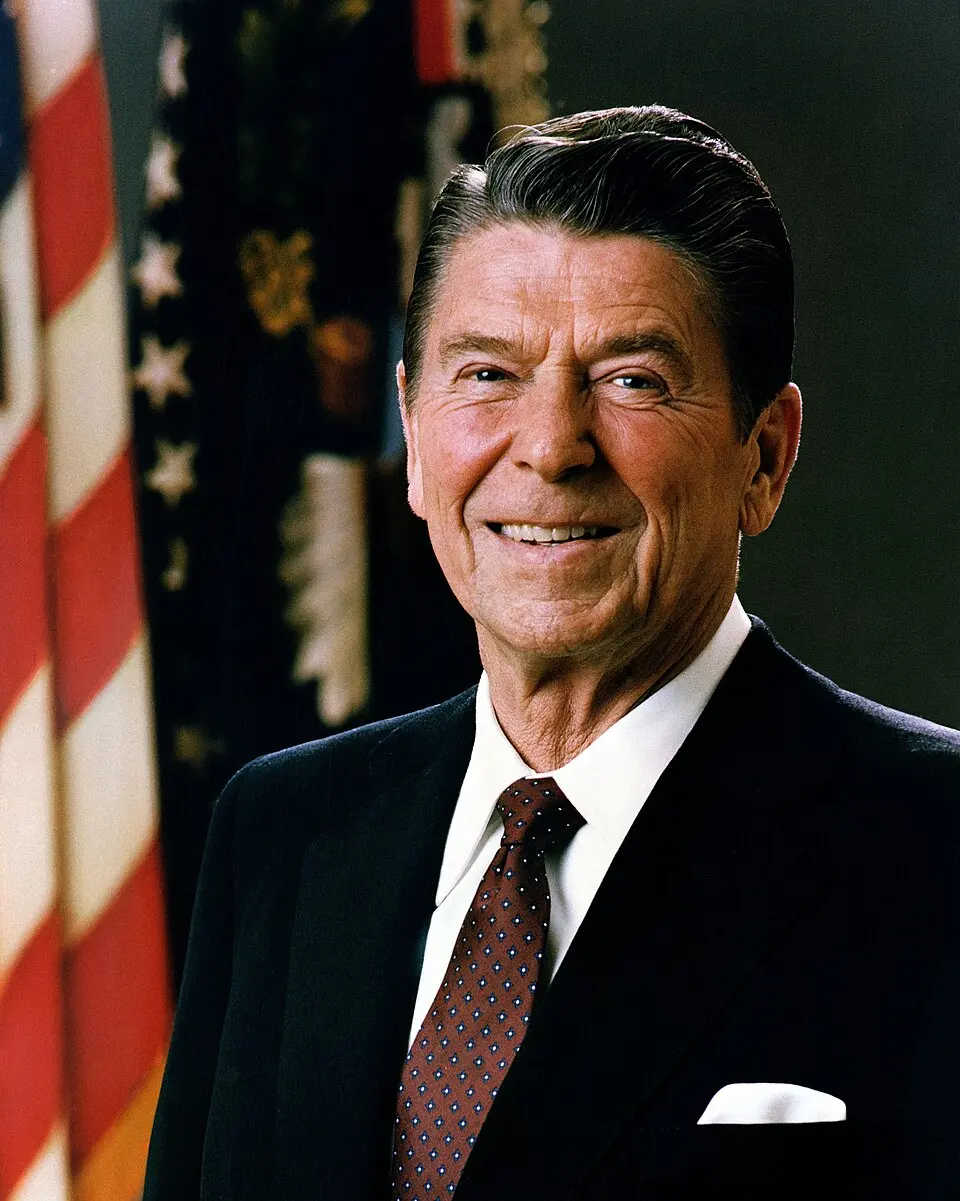
Era VIII · 1981–1989

The Reagan Era

Ronald Reagan joined tax cuts, a defense buildup and an openly anti-communist foreign policy into a governing program that remade the Republican Party and helped bring the Cold War toward its end—while leaving large deficits and lasting debates behind.

Overview

Ronald Reagan took office on January 20, 1981, promising to restore economic growth, rebuild American defenses and roll back the reach of the federal government. He arrived with a broad mandate—44 states and the first Republican Senate majority since the early 1950s—although Democrats held the House throughout his presidency. Minutes after he took the oath, Iran released the 52 Americans it had held hostage for 444 days. Ten weeks later he was shot in an assassination attempt outside the Washington Hilton; his recovery, and the good humor with which he faced it, strengthened his standing with the public and his hand with Congress.

Reagan’s economic program combined the Economic Recovery Tax Act of 1981, which cut income-tax rates across the board and indexed tax brackets to inflation, with a defense buildup, efforts to slow domestic spending and deregulation, while the Federal Reserve under Paul Volcker fought inflation with tight money. A severe recession in 1981–1982 gave way to an expansion that lasted until 1990, and inflation, above 13 percent in 1980, stayed near or below 4 percent from 1983 on. The administration also signed tax increases in 1982 and 1984, a bipartisan rescue of Social Security in 1983 and the Tax Reform Act of 1986, which lowered the top individual rate to 28 percent while closing loopholes. Deficits and the national debt nonetheless rose sharply, a legacy still argued over.

Abroad, Reagan treated détente as a failed bargain and pressed the Soviet Union ideologically, militarily and economically. In March 1983 he called it an “evil empire” and proposed the Strategic Defense Initiative, and his administration aided anti-communist forces from Afghanistan to Central America. U.S. forces landed on Grenada in October 1983, days after 241 American service members were killed in the bombing of the Marine barracks in Beirut. After Mikhail Gorbachev came to power in 1985, Reagan paired pressure with personal diplomacy in a series of summits, challenged him at the Brandenburg Gate in 1987 to “tear down this wall,” and signed the INF Treaty, the first agreement to eliminate an entire class of nuclear missiles.

The era had its setbacks and controversies. The Iran–Contra affair, disclosed in November 1986, revealed secret arms sales to Iran and the diversion of proceeds to the Nicaraguan Contras while Congress restricted such aid, and Democrats regained the Senate that year. The Senate rejected Robert Bork’s nomination to the Supreme Court in 1987, a fight that changed judicial confirmations. Yet Reagan left office with high approval ratings and a transformed party: Sandra Day O’Connor, Antonin Scalia and Anthony Kennedy had joined the Court, the Reagan coalition had drawn in blue-collar “Reagan Democrats” and evangelical voters, and Vice President George H. W. Bush won the 1988 election—the first sitting vice president elected president since 1836.

Timeline

  1. Reagan inaugurated; the hostages come home

    In his inaugural address Reagan declares that “government is not the solution to our problem; government is the problem.” Minutes after the ceremony, Iran releases the 52 American hostages it had held for 444 days.

    Historical Record
  2. Reagan survives an assassination attempt

    John Hinckley Jr. shoots Reagan outside the Washington Hilton, also wounding Press Secretary James Brady, Secret Service agent Timothy McCarthy and District of Columbia police officer Thomas Delahanty. Reagan becomes the first sitting president to survive being wounded by an assassin.

    Historical Record
  3. The air traffic controllers’ strike

    When thousands of federal air traffic controllers strike in violation of federal law, Reagan orders them back to work within 48 hours and then fires more than 11,000 who refuse. Supporters saw a demonstration of presidential resolve; organized labor saw a lasting blow to public-sector unions.

    Historical Record
  4. Economic Recovery Tax Act signed

    Signing the bill at his California ranch, Reagan enacts the core of the Kemp–Roth plan: individual income-tax rates fall by about 23 percent over three years, the top rate drops from 70 to 50 percent, and tax brackets are indexed to inflation beginning in 1985.

    Primary Source
  5. O’Connor joins the Supreme Court

    Confirmed 99–0, Sandra Day O’Connor of Arizona is sworn in as the first woman to serve on the Supreme Court, fulfilling a Reagan campaign pledge.

    Historical Record
  6. The “Evil Empire” speech

    Addressing the National Association of Evangelicals in Orlando, Reagan urges Americans not to treat the arms race as a misunderstanding between morally equivalent powers and calls the Soviet Union an “evil empire.”

    Primary Source
  7. The Strategic Defense Initiative

    In a televised address Reagan calls for research on defenses that could intercept strategic ballistic missiles. Critics dubbed the program “Star Wars” and doubted it could work; supporters argue it added to the pressure that brought the Soviets to serious arms talks.

    Primary Source
  8. Social Security is rescued

    Reagan signs a bipartisan plan, built on the recommendations of a commission chaired by Alan Greenspan and negotiated with House Speaker Tip O’Neill, that gradually raises the full retirement age to 67, taxes part of the benefits of higher-income retirees and accelerates scheduled payroll-tax increases.

    Primary Source
  9. U.S. forces land on Grenada

    Two days after 241 American service members were killed in the bombing of the Marine barracks in Beirut, U.S. forces land on Grenada following a coup by a pro-Cuban faction, citing the safety of American medical students and a request from Eastern Caribbean states. The military government is deposed within days.

    Historical Record
  10. Scalia joins the Court as Rehnquist becomes chief justice

    Antonin Scalia, confirmed 98–0, takes his seat as William Rehnquist is elevated to chief justice. Scalia becomes the leading judicial voice of originalism and textualism.

    Historical Record
  11. Tax Reform Act of 1986

    Reagan signs a bipartisan overhaul, shaped with Democrats such as Senator Bill Bradley and Representative Dan Rostenkowski, that cuts the top individual rate from 50 to 28 percent, lowers the corporate rate and pays for the cuts by closing loopholes, removing millions of low-income Americans from the income-tax rolls.

    Primary Source
  12. Immigration Reform and Control Act

    The Simpson–Mazzoli law, sponsored by Republican Senator Alan Simpson and Democratic Representative Romano Mazzoli, offers legal status to about 2.7 million unauthorized immigrants and penalizes employers who knowingly hire unauthorized workers. Critics later argued that the employer sanctions were weakly enforced, an argument that shaped every later immigration debate.

    Primary Source
  13. The Iran–Contra diversion is disclosed

    Attorney General Edwin Meese announces that proceeds from secret arms sales to Iran were diverted to the Nicaraguan Contras at a time when Congress had restricted such aid. National Security Adviser John Poindexter resigns, and National Security Council aide Oliver North is fired.

    Historical Record
  14. “Tear down this wall!”

    Speaking before the Berlin Wall at the Brandenburg Gate, Reagan challenges Soviet leader Mikhail Gorbachev to prove his commitment to reform: “Mr. Gorbachev, open this gate! Mr. Gorbachev, tear down this wall!”

    Primary Source
  15. The Senate rejects Robert Bork

    After a fierce national campaign over his judicial philosophy, the Senate rejects Judge Robert Bork’s Supreme Court nomination, 42–58; six Republicans join 52 Democrats in opposition. Anthony Kennedy, confirmed 97–0 in February 1988, takes the seat.

    Historical Record
  16. The INF Treaty

    Reagan and Gorbachev sign the Intermediate-Range Nuclear Forces Treaty, the first agreement to eliminate an entire class of nuclear missiles, with on-site verification. The Senate approved it 93–5 in May 1988.

    Primary Source

People

  • 40th President of the United States, 1981–1989

  • Vice President, 1981–1989

    George H. W. Bush

    Reagan’s chief rival for the 1980 nomination, he became a loyal vice president and his successor.

  • Associate Justice of the Supreme Court, 1981–2006

    Sandra Day O’Connor

    The first woman on the Court and, earlier, the first woman to lead a state senate as majority leader, in Arizona.

  • Associate Justice of the Supreme Court, 1986–2016

    Antonin Scalia

    The leading exponent of originalism and textualism on the modern Court.

  • U.S. Representative from New York, 1971–1989

    Jack Kemp

    Co-author of the Kemp–Roth tax cuts enacted in 1981 and a leading voice of supply-side economics.

  • U.S. Ambassador to the United Nations, 1981–1985

    Jeane Kirkpatrick

    The first woman to hold the post; a Democrat whose critique of Carter-era foreign policy drew Reagan’s attention.

  • Secretary of State, 1982–1989

    George P. Shultz

    Led the diplomacy with Gorbachev’s government that produced the INF Treaty.

  • Chairman of the Senate Finance Committee, 1981–1985; Senate Majority Leader, 1985–1987

    Bob Dole

    Managed the 1981 tax cut in the Senate and later pressed for deficit reduction.

  • U.S. Representative from Georgia, 1979–1999

    Newt Gingrich

    Founded the Conservative Opportunity Society in 1983 to push House Republicans toward a more confrontational strategy.

  • Surgeon General of the United States, 1982–1989

    C. Everett Koop

    An evangelical pediatric surgeon whose 1986 report on AIDS and 1988 national mailing led the federal public-health response.

Documents

Elections

YearElectionResultElectoral votes
1980Election of 1980Amid inflation, high interest rates and the Iran hostage crisis, Reagan won 44 states and 50.7 percent of the popular vote. Republicans gained 12 Senate seats and won the Senate for the first time since 1953–1955.Ronald Reagan (R) defeats Jimmy Carter (D) and John B. Anderson (Independent)489 of 538
19821982 Midterm ElectionsWith unemployment above 10 percent in the deepest recession since the 1930s, Democrats strengthened their House majority. Republicans held the Senate.Democrats gain 26 House seats—
1984Election of 1984Campaigning on recovery and peace through strength, Reagan carried 49 states and 58.8 percent of the popular vote, losing only Minnesota, Mondale’s home state, and the District of Columbia. His 525 electoral votes remain the most ever won.Ronald Reagan (R) defeats Walter Mondale (D)525 of 538
19861986 Midterm ElectionsDemocrats gained eight Senate seats for a 55–45 majority, which shaped the confirmation fight over Robert Bork the following year.Democrats regain the Senate—
1988Election of 1988Bush won 40 states and 53.4 percent of the popular vote, becoming the first sitting vice president elected president since Martin Van Buren in 1836. Democrats held both houses of Congress.George H. W. Bush (R) defeats Michael Dukakis (D)426 of 538

Policies

  • 1981–1986

    Tax policy: from the 1981 cuts to the 1986 reform

    The 1981 act cut rates and indexed brackets to inflation. As deficits grew, Reagan signed tax increases in 1982 and 1984 and accelerated payroll taxes in the 1983 Social Security rescue. The Tax Reform Act of 1986 then traded lower rates for a broader base, a model later cited by reformers in both parties.

    Historical Record
  • 1981

    Regulatory relief

    In his first weeks Reagan ended the remaining federal price controls on crude oil and gasoline and issued Executive Order 12291, requiring agencies to submit major regulations to cost–benefit review by the Office of Management and Budget—a practice every later administration has kept in some form.

    Historical Record
  • 1981–1988

    Defense buildup and the Strategic Defense Initiative

    Defense spending rose substantially in Reagan’s first term, funding new ships, aircraft and missiles, and in 1983 he launched research on missile defense. Supporters describe the buildup as “peace through strength”; critics called it wasteful and destabilizing.

    Historical Record
  • 1981–1988

    The Reagan Doctrine

    The administration aided anti-communist insurgencies, including the Afghan resistance to Soviet occupation and the Contras in Nicaragua, seeking not only to contain Soviet influence but to roll it back.

    Historical Record
  • 1983

    Martin Luther King Jr. Day

    After both houses passed the bill by wide bipartisan margins, Reagan signed legislation on November 2, 1983, making the third Monday in January a federal holiday honoring Dr. King, first observed in 1986.

    Historical Record
  • 1986

    Anti-Drug Abuse Act of 1986

    Passed with broad bipartisan support at the height of the crack-cocaine epidemic, the law created mandatory minimum sentences, including a 100-to-1 disparity between crack and powder cocaine. Later Congresses revisited those penalties in the Fair Sentencing Act of 2010 and the First Step Act of 2018.

    Historical Record
  • 1988

    Civil Liberties Act of 1988

    Reagan signed legislation formally apologizing for the wartime incarceration of Japanese Americans and providing $20,000 to each surviving detainee.

    Historical Record

Speeches

  • January 20, 1981

    First Inaugural Address

    Ronald Reagan

    Delivered from the West Front of the Capitol, the first inauguration held there, amid inflation and the Iran hostage crisis.

    “In this present crisis, government is not the solution to our problem; government is the problem.”
    Primary Source
  • March 8, 1983

    Remarks at the Annual Convention of the National Association of Evangelicals

    Ronald Reagan

    Arguing against a nuclear freeze, Reagan framed the Cold War as a moral struggle rather than a misunderstanding between equals.

    “…to ignore the facts of history and the aggressive impulses of an evil empire, to simply call the arms race a giant misunderstanding and thereby remove yourself from the struggle between right and wrong and good and evil.”
    Primary Source
  • March 4, 1987

    Address to the Nation on the Iran Arms and Contra Aid Controversy

    Ronald Reagan

    After the Tower Commission’s report, Reagan accepted responsibility for the arms sales to Iran.

    “A few months ago I told the American people I did not trade arms for hostages. My heart and my best intentions still tell me that’s true, but the facts and the evidence tell me it is not.”
    Primary Source
  • June 12, 1987

    Remarks on East–West Relations at the Brandenburg Gate

    Ronald Reagan

    Delivered in West Berlin over the objections of some advisers who thought the challenge to Gorbachev too provocative.

    “General Secretary Gorbachev, if you seek peace, if you seek prosperity for the Soviet Union and Eastern Europe, if you seek liberalization: Come here to this gate! Mr. Gorbachev, open this gate! Mr. Gorbachev, tear down this wall!”
    Primary Source
  • January 11, 1989

    Farewell Address to the Nation

    Ronald Reagan

    Reagan’s last Oval Office address, in which he returned to John Winthrop’s image of a “shining city upon a hill.”

    “But in my mind it was a tall, proud city built on rocks stronger than oceans, wind-swept, God-blessed, and teeming with people of all kinds living in harmony and peace…”
    Primary Source

Criticism & Debate

A historical institution earns trust by recording disagreement. It does not rewrite history around what a movement believes today. Each perspective below is stated in terms its own proponents would recognize.

Opposing View / Debate

What did Iran–Contra reveal about presidential power and accountability?

In 1985–1986 the administration secretly sold arms to Iran, in part to win the release of American hostages in Lebanon, and National Security Council staff diverted proceeds to the Contras while the Boland Amendment restricted such aid. The Tower Commission faulted Reagan’s detached management style. Independent Counsel Lawrence Walsh charged 14 people and won 11 convictions; Oliver North’s and John Poindexter’s were overturned on appeal because of their immunized congressional testimony, and in December 1992 President George H. W. Bush pardoned six others, including former Defense Secretary Caspar Weinberger.

Congressional majority and the independent counsel

The majority report of the congressional investigating committees (1987) and Walsh’s final report (1993) concluded that officials had deceived Congress, evaded the law and destroyed documents, and that responsibility reached the senior officials who set the policy in motion.

Congressional minority

The minority report, whose signers included Representative Dick Cheney of Wyoming, acknowledged serious mistakes but argued that there had been no constitutional crisis, that the Boland restrictions intruded on the president’s constitutional authority in foreign affairs, and that Congress’s shifting Contra policy shared the blame.

Reagan’s own account

In a March 1987 address Reagan accepted responsibility and acknowledged that an opening to Iran had deteriorated into trading arms for hostages. He maintained that he had not known of the diversion, and investigators found no credible evidence that he had.

Sources

  1. Final Report of the Independent Counsel for Iran/Contra Matters · Federation of American Scientists (text of the 1993 report)
  2. Address to the Nation on the Iran Arms and Contra Aid Controversy · The American Presidency Project, UC Santa Barbara
Opposing View / Debate

Were the Reagan deficits a price worth paying?

Gross federal debt rose from about $1 trillion at the end of fiscal 1981 to about $2.6 trillion at the end of fiscal 1988, as tax cuts, higher defense spending, a deep recession and rising entitlement costs outpaced spending restraint. Reagan also signed several deficit-reduction measures, including tax increases in 1982 and 1984 and the Gramm–Rudman–Hollings Act of 1985.

Supporters

Supporters argue that the defense buildup helped end the Cold War on American terms, that lower tax rates helped produce one of the longest peacetime expansions in the nation’s history, and that deficits persisted because a Democratic House resisted spending cuts.

Critics

Critics, including Reagan’s first budget director, David Stockman, in his later account, argue that the administration never matched its tax cuts with realistic spending reductions, that deficits kept interest rates and the trade deficit high, and that the era made peacetime borrowing routine.

Fiscal conservatives

Many fiscal conservatives see the 1980s as the point where the party’s traditional insistence on balanced budgets gave way to an emphasis on tax cuts—a tension that returned in every later period of Republican government.

Sources

  1. Historical Debt Outstanding · U.S. Department of the Treasury, Fiscal Data
Opposing View / Debate

Did supply-side tax cuts work?

Supply-side economists and politicians—among them Arthur Laffer, Robert Mundell, Jude Wanniski and Representative Jack Kemp—argued that lower marginal tax rates would increase work, saving and investment enough to produce strong growth. The 1981 act put the theory into practice, and its results remain contested.

Supporters

Supporters credit lower rates, together with deregulation and falling inflation, for an expansion that ran from late 1982 to 1990, a surge of entrepreneurship and the worldwide movement toward lower top tax rates, including the bipartisan 1986 reform.

Critics

Critics—including George H. W. Bush, who derided Reagan’s plan during the 1980 primaries—argue that revenues fell far short of supply-side projections, that the Federal Reserve’s tight money deserves most of the credit for ending inflation, and that the gains went disproportionately to high earners.

A common middle view

Many economists across the spectrum conclude that the rate cuts improved incentives and recovered part of their cost through faster growth, but did not pay for themselves.

Opposing View / Debate

Did the Reagan administration respond adequately to the AIDS epidemic?

The Centers for Disease Control reported the first cases of what became known as AIDS in June 1981. By the time Reagan gave his first major speech on the disease, in May 1987, tens of thousands of Americans had been diagnosed and thousands had died. Federal research funding grew quickly, often beyond what the administration requested.

Critics

AIDS activists, many public-health officials and historians argue that presidential leadership came too late, that Congress repeatedly had to appropriate more for AIDS research than the administration requested, and that stigma toward gay men and drug users slowed prevention and research.

Defenders

Defenders note that federal AIDS spending rose every year, that Surgeon General C. Everett Koop’s 1986 report and the 1988 mailing of Understanding AIDS to 107 million households were unprecedented public-health efforts, and that Reagan created the first presidential commission on the epidemic in 1987.

A debate inside the administration

Officials disagreed among themselves. Koop, an evangelical conservative, urged frank sex education and condom use to stop transmission; others, including Education Secretary William Bennett, emphasized abstinence and moral instruction and resisted Koop’s approach.

Sources

  1. A Timeline of HIV and AIDS · HIV.gov, U.S. Department of Health and Human Services

Images

Archival image collections. Rights are checked item by item before anything is reproduced on this site.

Sources

Sources

  1. Ronald Reagan · Miller Center, University of Virginia
  2. 1980 Presidential Election · The American Presidency Project, UC Santa Barbara
  3. 1984 Presidential Election · The American Presidency Project, UC Santa Barbara
  4. Party Divisions of the House of Representatives · Office of the Historian, U.S. House of Representatives
  5. Historical Debt Outstanding · U.S. Department of the Treasury, Fiscal Data
  6. Intermediate-Range Nuclear Forces Treaty (INF Treaty) · U.S. Department of State (archived)
  7. Final Report of the Independent Counsel for Iran/Contra Matters · Federation of American Scientists (text of the 1993 report)
  8. A Timeline of HIV and AIDS · HIV.gov, U.S. Department of Health and Human Services

Related

Continue in the Archive