41st President · 1989–1993

George H. W. Bush

A World War II naval aviator and veteran diplomat who guided the peaceful end of the Cold War, led the coalition that liberated Kuwait and signed the Americans with Disabilities Act.

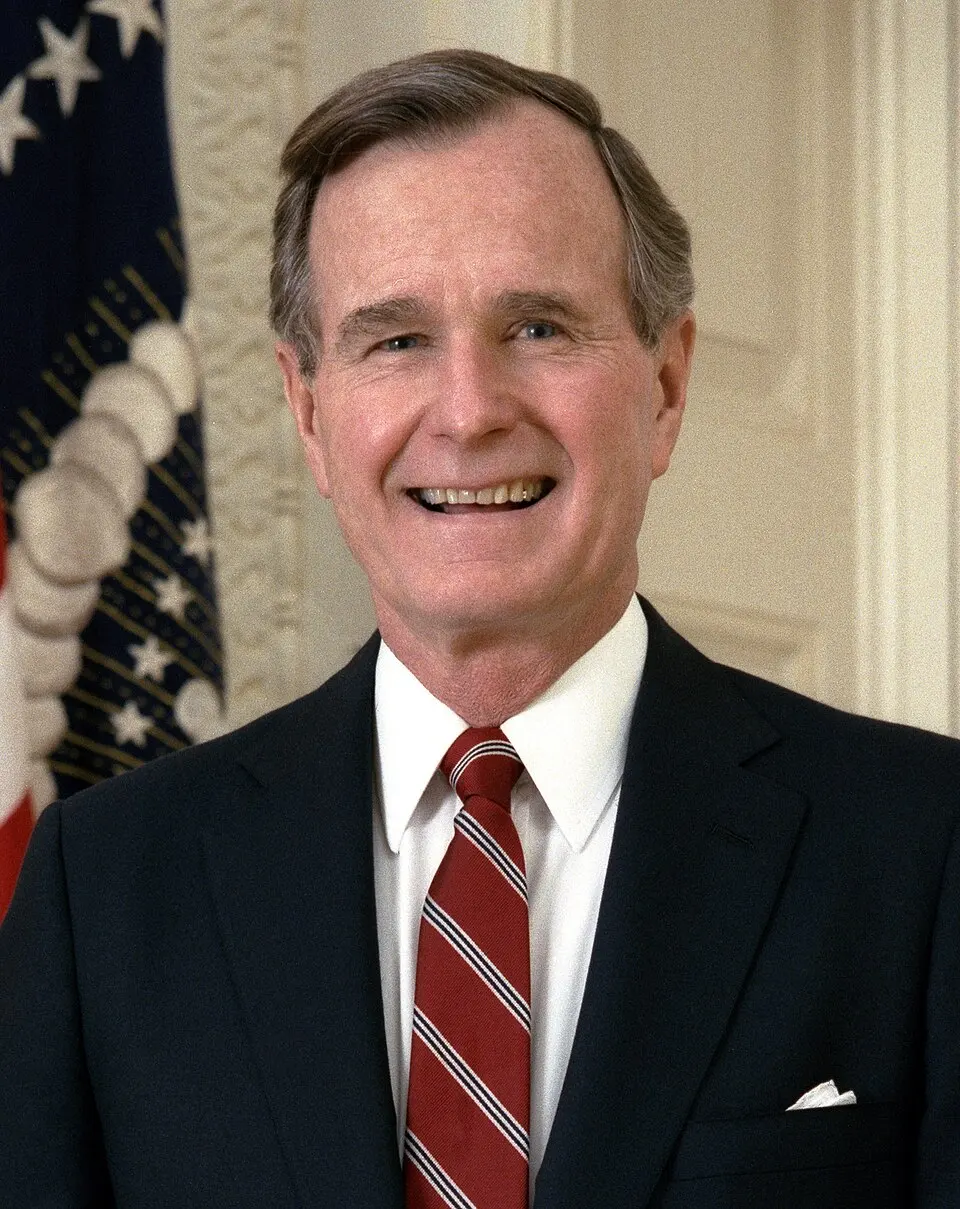
Portrait of George H. W. Bush
George H. W. Bush, February 15, 1989Photo: David Valdez, The White HousePublic domainSource of this photograph (opens in a new tab)
Born
June 12, 1924Milton, Massachusetts
Died
November 30, 2018
Home state
Texas
Vice president
Dan Quayle

Life & Offices

The son of Connecticut Senator Prescott Bush, George Bush enlisted in the Navy on his eighteenth birthday and became one of its youngest aviators; shot down over the Pacific in 1944, he was rescued by a submarine. After graduating from Yale he moved to Texas, entered the oil business and then politics, winning a House seat in 1966. He went on to hold a series of appointed posts — ambassador to the United Nations, Republican national chairman, envoy to China and director of central intelligence — before serving eight years as Ronald Reagan’s vice president.

Elected in 1988 over Michael Dukakis, the first sitting vice president elected president since 1836, Bush managed the end of the Cold War with restraint: the fall of the Berlin Wall, the reunification of Germany within NATO, the START I arms reduction treaty and the dissolution of the Soviet Union in December 1991. When Iraq invaded Kuwait in August 1990, he assembled a broad coalition under United Nations authority and won congressional approval for the use of force; Operation Desert Storm expelled Iraqi forces after five weeks of air strikes and a 100-hour ground war.

At home Bush signed the Americans with Disabilities Act, the Clean Air Act Amendments of 1990 and the Civil Rights Act of 1991, and he appointed Justices David Souter and Clarence Thomas. His 1990 budget agreement with congressional Democrats raised taxes despite his 1988 campaign pledge of “no new taxes.” A recession, the reversal on taxes and a primary challenge from Pat Buchanan weakened him, and he lost the 1992 election to Bill Clinton in a three-way race that included Ross Perot.

Offices before the presidency

  • U.S. Navy pilot (1942–1945)
  • U.S. House of Representatives, Texas (1967–1971)
  • U.S. Ambassador to the United Nations (1971–1973)
  • Chairman of the Republican National Committee (1973–1974)
  • Chief of the U.S. Liaison Office in Beijing (1974–1975)
  • Director of Central Intelligence (1976–1977)
  • Vice President of the United States (1981–1989)

Eras: VIII. The Reagan Era · IX. The Bush Era and Post–Cold War Republicanism

The Record

  • 1989–1990

    Points of Light and national service

    Bush made volunteer service a signature theme, recognizing a “Daily Point of Light” for community service, and signed the National and Community Service Act of 1990.

    Historical Record
  • 1989–1991

    End of the Cold War in Europe

    Bush avoided triumphal gestures as communist governments fell across Eastern Europe in 1989, worked with Mikhail Gorbachev and West German Chancellor Helmut Kohl toward the reunification of Germany within NATO in October 1990, and signed the START I treaty reducing strategic nuclear arsenals in July 1991.

    Historical Record
  • 1989

    Operation Just Cause

    U.S. forces invaded Panama in December 1989 and removed its military ruler, Manuel Noriega, who was brought to the United States to face drug-trafficking charges.

    Historical Record
  • 1990

    Americans with Disabilities Act

    Signed July 26, 1990, the act prohibited discrimination against people with disabilities in employment, public services and public accommodations and required accessible facilities and transportation.

    Primary Source
  • 1990

    Clean Air Act Amendments of 1990

    The amendments created a market-based cap-and-trade system to cut the sulfur dioxide emissions that cause acid rain and tightened controls on urban smog and toxic air pollutants.

    Historical Record
  • 1990

    Deficit-reduction agreement

    Facing rising deficits, Bush agreed with congressional leaders on a package of spending restraints and tax increases, including a higher top income-tax rate, along with caps on discretionary spending and pay-as-you-go rules for taxes and entitlements.

    Historical Record
  • 1990–1991

    Persian Gulf War

    After Iraq’s invasion of Kuwait, Bush built a coalition of more than thirty nations, won United Nations Security Council authorization and a January 1991 congressional vote, and led Operation Desert Storm, which liberated Kuwait by the end of February 1991.

    Historical Record
  • 1990–1991

    Supreme Court appointments

    Bush appointed David Souter in 1990 and Clarence Thomas, who was confirmed 52 to 48 in 1991 after contentious hearings.

    Historical Record
  • 1992

    North American Free Trade Agreement

    Bush signed NAFTA with Canada and Mexico in December 1992; Congress approved it under President Clinton the following year.

    Historical Record

Criticism & Debate

Opposing View / Debate

Was breaking the “no new taxes” pledge a betrayal or an act of responsibility?

Bush accepted the 1990 budget agreement, which included tax increases, after pledging in his 1988 convention speech that he would not raise taxes. House Republicans led by Minority Whip Newt Gingrich opposed the deal, and it became a central issue in Pat Buchanan’s 1992 primary challenge.

Conservative critics

Many conservatives saw a broken promise that undermined trust in the party and conceded the argument that deficits should be closed with higher taxes rather than spending restraint.

Defenders

Defenders argue that the agreement’s spending caps and pay-as-you-go rules helped produce the budget surpluses of the late 1990s. In 2014 the John F. Kennedy Library Foundation gave Bush its Profile in Courage Award for the decision.

Sources

  1. George H. W. Bush: Domestic Affairs · Miller Center, University of Virginia
Opposing View / Debate

Should the Gulf War have ended with Saddam Hussein still in power?

Coalition forces halted the ground war on February 28, 1991, after expelling Iraq from Kuwait. Uprisings by Iraqi Shiites and Kurds that spring were crushed by Saddam Hussein’s forces.

Bush and his advisers

Bush and national security adviser Brent Scowcroft argued that the United Nations mandate covered only the liberation of Kuwait, and that marching on Baghdad would have broken the coalition and required a long, costly occupation.

Critics

Critics argued that stopping when they did left a dangerous dictator in power, abandoned Iraqi rebels whom Bush had encouraged to rise up, and set the stage for later conflict with Iraq.

Sources

  1. George H. W. Bush: Foreign Affairs · Miller Center, University of Virginia

Documents

Sources

  1. George H. W. Bush · Miller Center, University of Virginia
  2. George H. W. Bush · White House Historical Association
  3. George Bush: Presidential Documents · The American Presidency Project, UC Santa Barbara
  4. George H.W. Bush Presidential Library and Museum · National Archives
  5. BUSH, George Herbert Walker · U.S. House of Representatives: History, Art & Archives