43rd President · 2001–2009

George W. Bush

A two-term governor of Texas and son of the forty-first president, whose presidency was defined by the response to the September 11 attacks and the wars in Afghanistan and Iraq.

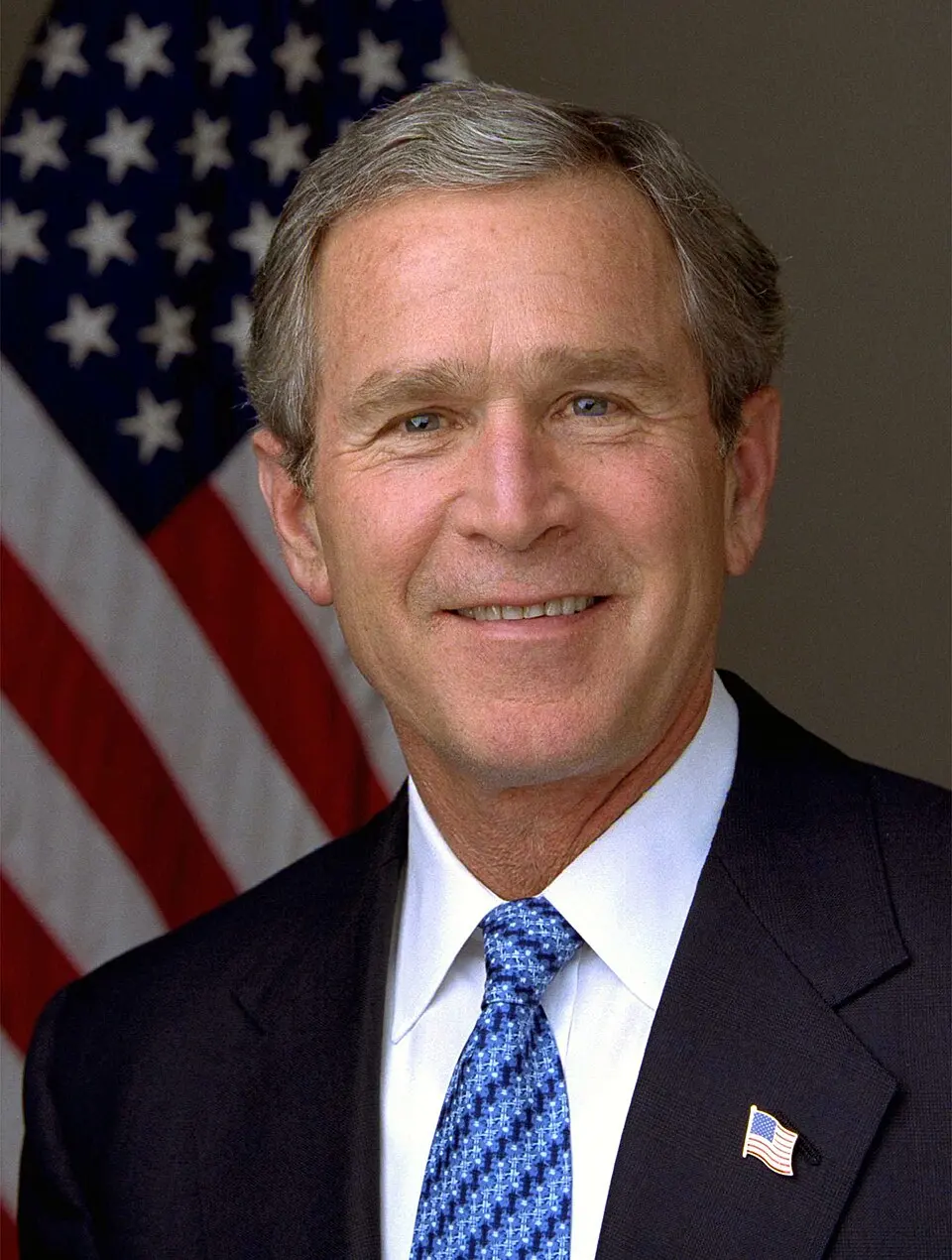
Portrait of George W. Bush
George W. Bush, January 14, 2003Photo: Eric Draper, The White HousePublic domainSource of this photograph (opens in a new tab)
Born
July 6, 1946New Haven, Connecticut
Home state
Texas
Vice president
Dick Cheney

Life & Offices

The eldest son of George H. W. and Barbara Bush, George W. Bush grew up in Midland and Houston, Texas, graduated from Yale and Harvard Business School, flew fighter jets in the Texas Air National Guard and worked in the oil industry before becoming managing general partner of the Texas Rangers baseball club. Elected governor of Texas in 1994, he won reelection in 1998 by a wide margin.

Bush won the presidency in 2000 over Vice President Al Gore after a five-week recount dispute in Florida ended with the Supreme Court’s decision in Bush v. Gore; Gore won the national popular vote. Bush campaigned as a “compassionate conservative,” and his first two years brought a major tax cut and the bipartisan No Child Left Behind education law. The terrorist attacks of September 11, 2001, transformed his presidency: he launched a war against al-Qaeda and the Taliban in Afghanistan, created the Department of Homeland Security and in 2003 led an invasion of Iraq that removed Saddam Hussein.

Reelected in 2004, Bush pressed unsuccessfully for Social Security personal accounts and comprehensive immigration reform. In Iraq a costly insurgency and sectarian violence followed the invasion until a 2007 troop surge helped reduce the violence. His administration’s response to Hurricane Katrina in 2005 drew sharp criticism, and in the fall of 2008 he signed emergency legislation to stabilize the financial system during the worst crisis since the Great Depression. After leaving office he founded his presidential center in Dallas.

Offices before the presidency

  • Texas Air National Guard pilot (1968–1973)
  • Governor of Texas (1995–2000)

Era: IX. The Bush Era and Post–Cold War Republicanism

The Record

  • 2001–2003

    Tax cuts of 2001 and 2003

    The Economic Growth and Tax Relief Reconciliation Act lowered income-tax rates, doubled the child tax credit over time and phased down the estate tax; a 2003 law accelerated the cuts and reduced taxes on dividends and capital gains.

    Historical Record
  • 2001

    Response to September 11

    In an address to a joint session of Congress on September 20, 2001, Bush identified al-Qaeda as responsible for the attacks and demanded that the Taliban hand over its leaders. U.S. and allied forces began operations in Afghanistan on October 7, toppling the Taliban government within weeks.

    Primary Source
  • 2001–2002

    USA PATRIOT Act and the Department of Homeland Security

    The PATRIOT Act of October 2001 expanded surveillance and information-sharing powers for counterterrorism, and the Homeland Security Act of 2002 merged twenty-two federal agencies into a new cabinet department.

    Historical Record
  • 2002

    No Child Left Behind Act

    Passed with bipartisan support, the law required annual testing in reading and mathematics in grades three through eight and held schools accountable for the progress of every group of students.

    Historical Record
  • 2003–2008

    Iraq War

    Acting under an October 2002 congressional authorization, U.S.-led forces invaded Iraq in March 2003 and removed Saddam Hussein’s government. An insurgency and sectarian conflict followed; in 2007 Bush ordered a surge of more than 20,000 additional troops.

    Historical Record
  • 2003

    PEPFAR

    The President’s Emergency Plan for AIDS Relief committed $15 billion over five years to fight HIV/AIDS, primarily in Africa, and was reauthorized with bipartisan support in 2008.

    Historical Record
  • 2003

    Medicare prescription drug benefit

    The Medicare Modernization Act created Part D, a prescription drug benefit delivered through private insurance plans — the largest expansion of Medicare since its creation.

    Historical Record
  • 2005–2006

    Supreme Court appointments

    Bush appointed John Roberts as chief justice and Samuel Alito as an associate justice.

    Historical Record
  • 2008

    Response to the financial crisis

    As the financial system neared collapse in September 2008, Bush signed the Emergency Economic Stabilization Act, creating the $700 billion Troubled Asset Relief Program to recapitalize banks; funds were later extended to the auto industry.

    Historical Record

Criticism & Debate

Opposing View / Debate

Did the administration misrepresent the intelligence on Iraq’s weapons?

The central public case for the 2003 invasion was that Iraq possessed chemical and biological weapons and was reconstituting a nuclear program. The Iraq Survey Group found no stockpiles, and in 2005 a presidential commission concluded that the intelligence community had been “dead wrong in almost all of its pre-war judgments” about Iraq’s weapons.

Critics

Critics, including many Democrats and some Republicans, argue that administration officials presented uncertain intelligence as settled fact, emphasized alleged links between Saddam Hussein and al-Qaeda that intelligence analysts doubted, and went to war without adequate plans for the occupation.

The administration and its defenders

Bush and his defenders note that intelligence services in the United States and allied countries shared the mistaken assessments, that Congress saw much of the same intelligence when it authorized force, and that both the Senate Intelligence Committee and the 2005 commission found no evidence that analysts changed their judgments under political pressure.

Sources

  1. Address to the Nation on Iraq, March 17, 2003 · The American Presidency Project, UC Santa Barbara
  2. George W. Bush: Foreign Affairs · Miller Center, University of Virginia
Opposing View / Debate

Were the post-9/11 security measures justified?

After September 11 the administration authorized warrantless surveillance of some international communications, held suspected terrorists at Guantánamo Bay without trial and approved “enhanced interrogation techniques,” including waterboarding, for some detainees held by the CIA.

Supporters

Supporters argue that these measures were lawful wartime responses, grounded in the legal opinions of the time, that helped prevent another major attack on the United States during Bush’s presidency.

Critics

Critics, including Republican Senator John McCain, argued that waterboarding was torture and that indefinite detention and warrantless surveillance violated American law and values. The Supreme Court ruled against the administration on detainees’ rights in cases including Hamdan v. Rumsfeld (2006) and Boumediene v. Bush (2008).

Documents

Sources

  1. George W. Bush · Miller Center, University of Virginia
  2. George W. Bush · White House Historical Association
  3. George W. Bush: Presidential Documents · The American Presidency Project, UC Santa Barbara
  4. George W. Bush Presidential Library and Museum · National Archives