37th President · 1969–1974

Richard Nixon

A Cold War strategist who opened relations with China, pursued détente and signed landmark environmental laws before becoming the only president to resign.

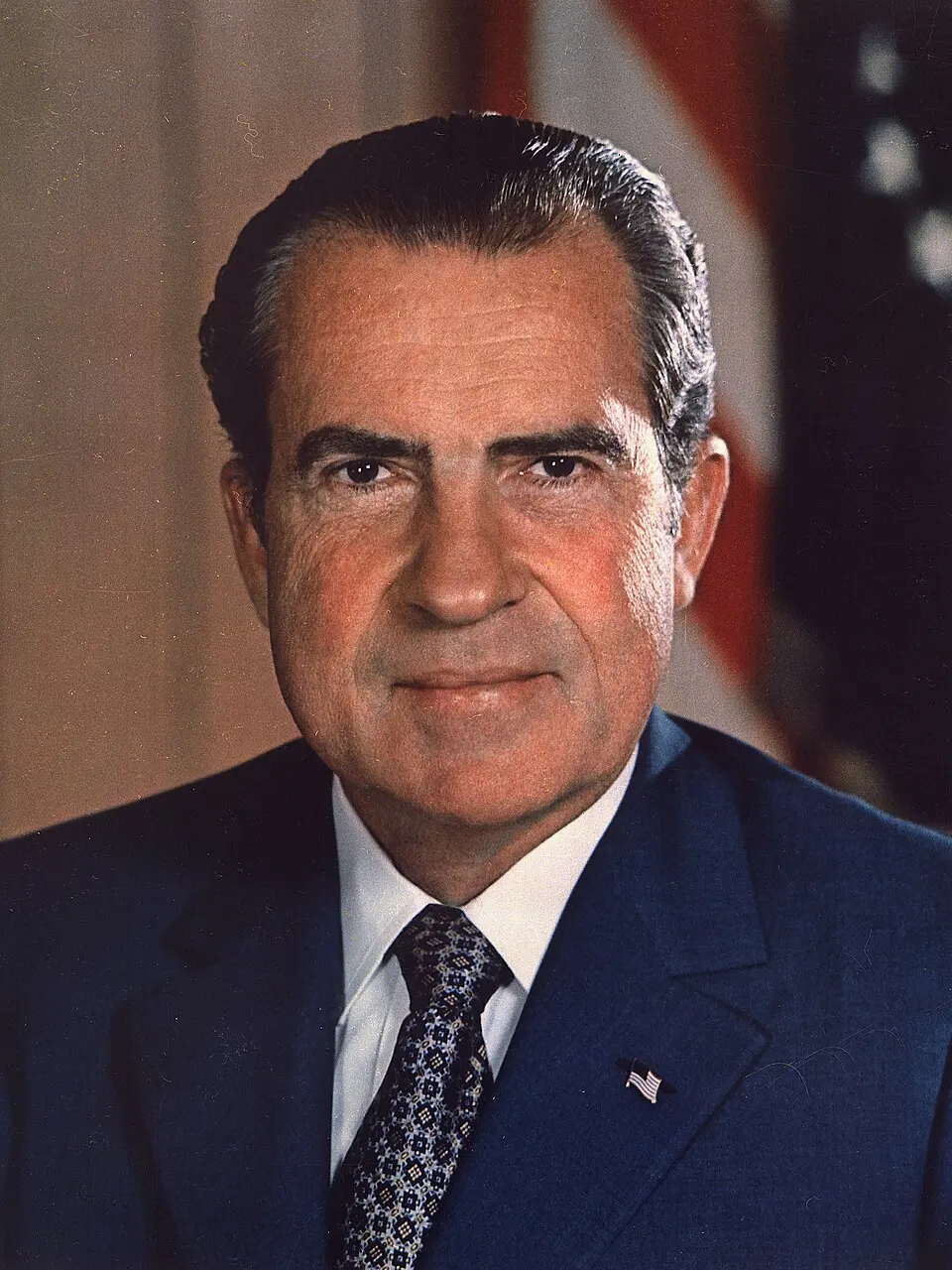
Portrait of Richard Nixon
Richard Nixon, June 1, 1972Photo: U.S. Army Audiovisual Center, National ArchivesPublic domainSource of this photograph (opens in a new tab)
Born
January 9, 1913Yorba Linda, California
Died
April 22, 1994
Home state
California
Vice presidents
Spiro T. Agnew, Gerald R. Ford

Life & Offices

The son of a struggling grocer in Southern California, Nixon graduated from Whittier College and Duke University’s law school and served as a Navy officer in the Pacific. Elected to Congress in 1946, he gained national prominence on the House Un-American Activities Committee during the Alger Hiss case, won a Senate seat in 1950 and at thirty-nine was elected Dwight Eisenhower’s vice president.

After narrowly losing the 1960 presidential race to John F. Kennedy and the 1962 California governor’s race, Nixon won the presidency in 1968, promising law and order and an honorable end to the Vietnam War. He gradually withdrew American ground forces while expanding the air war and sending troops into Cambodia in 1970, and the Paris Peace Accords of January 1973 ended direct U.S. military involvement. His visit to China in February 1972 and arms agreements with the Soviet Union that May reshaped the Cold War.

At home Nixon signed major environmental and regulatory laws, ended the draft and embraced self-determination for Native nations. Reelected in a forty-nine-state landslide in 1972, he was soon engulfed by the Watergate scandal — a break-in at Democratic headquarters by operatives tied to his reelection campaign, and the White House effort to cover it up. Facing near-certain impeachment and removal after White House tapes showed he had approved obstructing the investigation, Nixon resigned on August 9, 1974. President Ford pardoned him a month later.

Offices before the presidency

  • U.S. Navy officer (1942–1946)
  • U.S. House of Representatives, California (1947–1950)
  • U.S. Senate, California (1950–1953)
  • Vice President of the United States (1953–1961)

Eras: VI. Eisenhower and the Cold War · VII. Goldwater and the Conservative Movement

The Record

  • 1970–1973

    Environmental laws and the EPA

    Nixon signed the National Environmental Policy Act on January 1, 1970, created the Environmental Protection Agency by reorganization plan that year, and signed the Clean Air Act of 1970 and the Endangered Species Act of 1973. He vetoed the 1972 Clean Water Act as too costly; Congress overrode the veto.

    Historical Record
  • 1970

    Self-determination for Native nations

    In a July 1970 special message, Nixon repudiated the policy of terminating tribes’ federal status and declared that self-determination “can and must be encouraged without the threat of eventual termination,” a shift later written into law.

    Primary Source
  • 1971

    New Economic Policy

    On August 15, 1971, Nixon suspended the convertibility of the dollar into gold, ending the Bretton Woods monetary system, and imposed a 90-day freeze on wages and prices.

    Historical Record
  • 1971–1972

    Twenty-sixth Amendment and Title IX

    The amendment lowering the voting age to eighteen was ratified in 1971. In 1972 Nixon signed the Education Amendments, whose Title IX barred sex discrimination in federally funded education programs.

    Historical Record
  • 1972

    Opening to China

    After secret diplomacy by national security adviser Henry Kissinger, Nixon visited China in February 1972, met Mao Zedong and issued the Shanghai Communiqué, beginning the normalization of relations.

    Historical Record
  • 1972

    Détente and arms control

    At a Moscow summit in May 1972, Nixon and Soviet leader Leonid Brezhnev signed the Anti-Ballistic Missile Treaty and an interim agreement limiting strategic offensive arms, known as SALT I.

    Historical Record
  • 1969–1973

    Vietnamization and the Paris Peace Accords

    Nixon reduced U.S. troop levels in Vietnam from more than 500,000 in 1969 to about 25,000 by the end of 1972 while shifting combat to South Vietnamese forces. The January 1973 Paris accords ended the U.S. combat role and brought American prisoners of war home.

    Historical Record
  • 1973

    End of the draft

    Following the recommendations of a presidential commission, the administration moved to an all-volunteer military, and conscription ended in 1973.

    Historical Record

Criticism & Debate

Opposing View / Debate

What does Watergate teach about presidential power?

In June 1972 burglars connected to Nixon’s reelection committee were arrested inside the Democratic National Committee’s offices at the Watergate complex. Investigations by the press, a Senate select committee and a special prosecutor revealed a cover-up directed from the White House and other abuses of power. In July 1974 the Supreme Court unanimously ordered the release of subpoenaed White House tapes, and the House Judiciary Committee approved three articles of impeachment. After a newly released tape showed Nixon had approved efforts to obstruct the FBI’s investigation, Republican congressional leaders told him he had lost the votes to survive, and he resigned.

The House Judiciary Committee and most historians

The committee’s bipartisan majority concluded that Nixon had obstructed justice, abused the powers of his office and defied congressional subpoenas. Most historians regard his resignation as proof that the constitutional system of checks worked.

Nixon and his defenders

Nixon maintained that he had no advance knowledge of the break-in. He and his defenders argued that many of his actions were motivated by national security concerns, and that earlier presidents had used wiretaps and federal agencies against opponents without being driven from office.

Sources

  1. Address to the Nation Announcing Decision To Resign the Office of President · The American Presidency Project, UC Santa Barbara
  2. Richard Nixon: Campaigns and Elections · Miller Center, University of Virginia
Opposing View / Debate

Was Nixon a conservative?

Nixon won the presidency by appealing to what he called “the great silent majority” of Americans uneasy with protest and disorder, yet much of his domestic record expanded federal regulation and spending.

Conservative critics

Conservatives objected to wage and price controls, his proposal for a guaranteed minimum income for families, growing federal spending and regulation, and détente with the communist powers.

Admirers of his pragmatism

Others credit Nixon with a pragmatic record that produced lasting environmental protections, oversaw the peaceful desegregation of many Southern school districts, and pursued a realist foreign policy that exploited divisions in the communist world.

Critics on the left

Liberal critics fault his expansion of the war into Cambodia, electoral appeals to racial and cultural resentment often described as a “Southern strategy,” and his treatment of the press and political opponents as enemies.

Documents

Sources

  1. Richard Nixon · Miller Center, University of Virginia
  2. Richard M. Nixon · White House Historical Association
  3. Richard Nixon: Presidential Documents · The American Presidency Project, UC Santa Barbara
  4. Richard Nixon Presidential Library and Museum · National Archives
  5. NIXON, Richard Milhous · U.S. House of Representatives: History, Art & Archives