38th President · 1974–1977

Gerald R. Ford

The only president never elected to the presidency or vice presidency, who sought to heal the nation after Watergate and pardoned his predecessor.

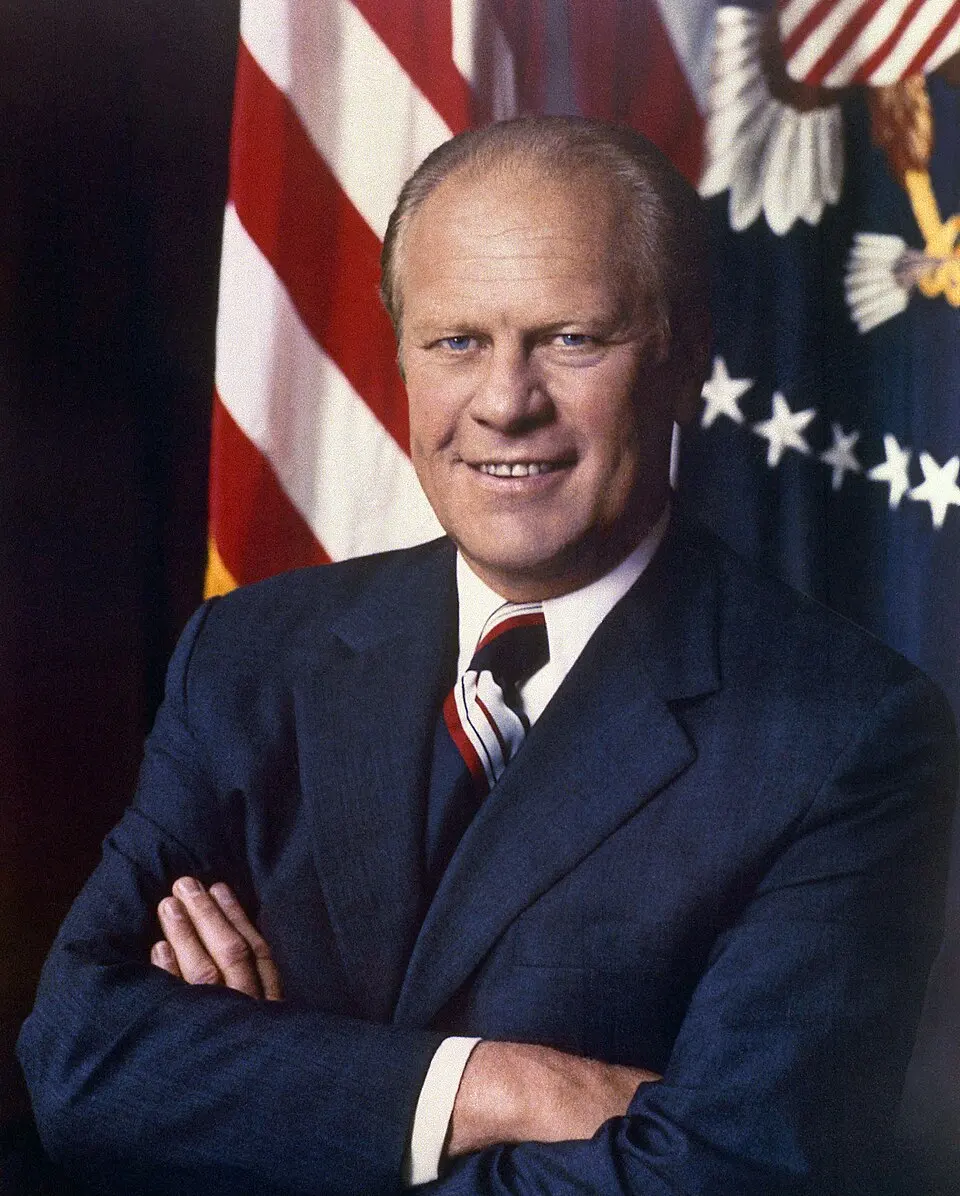
Portrait of Gerald R. Ford
Gerald R. Ford, August 27, 1974Photo: David Hume Kennerly, National ArchivesPublic domainSource of this photograph (opens in a new tab)
Born
July 14, 1913Omaha, Nebraska
Died
December 26, 2006
Home state
Michigan
Vice president
Nelson A. Rockefeller

Life & Offices

Born Leslie Lynch King Jr., Ford took the name of his stepfather and grew up in Grand Rapids, Michigan. He played on the University of Michigan’s national championship football teams of 1932 and 1933, earned a law degree at Yale and served aboard the aircraft carrier Monterey in the Pacific during World War II. Elected to Congress in 1948, he served nearly twenty-five years, became House Republican leader in 1965 and sat on the Warren Commission that investigated President Kennedy’s assassination.

When Vice President Spiro Agnew resigned in 1973, Nixon nominated Ford as the first vice president chosen under the Twenty-fifth Amendment, and Congress confirmed him by wide margins. Eight months later Nixon resigned, and Ford took the oath on August 9, 1974, telling the nation that “our long national nightmare is over.” One month later he granted Nixon a full pardon, a decision that cost him dearly in public approval.

Ford confronted high inflation and recession, the fall of South Vietnam in April 1975 and conflict with a Democratic Congress, vetoing dozens of bills. He signed the Helsinki Final Act, whose human rights commitments dissidents in the Soviet bloc later invoked, and survived two assassination attempts in September 1975. After defeating Ronald Reagan for the 1976 nomination, he lost narrowly to Jimmy Carter. Ford later received the Presidential Medal of Freedom and, in 2001, the John F. Kennedy Profile in Courage Award for the Nixon pardon.

Offices before the presidency

  • U.S. Navy officer (1942–1946)
  • U.S. House of Representatives, Michigan (1949–1973)
  • House Minority Leader (1965–1973)
  • Vice President of the United States (1973–1974)

Era: VII. Goldwater and the Conservative Movement

The Record

  • 1974

    Taking office after Watergate

    Ford became president on August 9, 1974, the only person to serve as both vice president and president without being elected to either office. On taking the oath he told Americans that “truth is the glue that holds government together.”

    Primary Source
  • 1974

    Pardon of Richard Nixon

    Proclamation 4311 of September 8, 1974, granted Nixon “a full, free, and absolute pardon” for all federal offenses he committed or may have committed during his presidency.

    Primary Source
  • 1974

    Clemency for Vietnam-era draft evaders and deserters

    A week after the Nixon pardon, Ford offered conditional clemency to draft evaders and military deserters who agreed to perform alternative service.

    Historical Record
  • 1975

    Evacuation of Saigon and refugee resettlement

    As North Vietnamese forces took Saigon in April 1975, U.S. helicopters evacuated the remaining Americans and thousands of South Vietnamese. Ford then pressed a reluctant Congress to fund the resettlement of Southeast Asian refugees in the United States.

    Historical Record
  • 1975

    Helsinki Final Act

    Ford joined the leaders of 34 other nations in signing the accords, which recognized postwar European borders and committed the signatories to respect human rights. Critics saw a concession to Soviet control of Eastern Europe; dissidents later used the human rights provisions to press their governments.

    Historical Record
  • 1975

    Energy Policy and Conservation Act

    Responding to the oil shocks, the act created the Strategic Petroleum Reserve and the first federal fuel-economy standards for automobiles.

    Historical Record
  • 1976

    An American Promise

    Proclamation 4417 formally confirmed the termination of Executive Order 9066, which had authorized the removal and incarceration of Japanese Americans during World War II. “We now know what we should have known then,” Ford wrote — that the evacuation was wrong and that Japanese Americans were and are loyal Americans.

    Primary Source

Criticism & Debate

Opposing View / Debate

Was the Nixon pardon an act of healing or an unjust exemption?

Ford’s approval rating fell sharply after the pardon, and suspicion that it had been arranged in advance persisted. In October 1974 Ford appeared before a House Judiciary subcommittee and testified that there had been “no deal, period.”

Critics

Critics argued that the pardon placed a former president above the law and denied the country a full judicial accounting of Watergate. Many believe it contributed to Ford’s narrow defeat in 1976.

Ford and his defenders

Ford said a prosecution would have consumed the country and his presidency for years, and he noted that accepting a pardon implied an admission of guilt. Over time many former critics, including Senator Edward Kennedy, came to praise the decision, and Ford received the Profile in Courage Award for it in 2001.

Sources

  1. Gerald Ford: Domestic Affairs · Miller Center, University of Virginia

Documents

Sources

  1. Gerald Ford · Miller Center, University of Virginia
  2. Gerald R. Ford · White House Historical Association
  3. Gerald R. Ford: Presidential Documents · The American Presidency Project, UC Santa Barbara
  4. Gerald R. Ford Presidential Library and Museum · National Archives
  5. FORD, Gerald Rudolph, Jr. · U.S. House of Representatives: History, Art & Archives