34th President · 1953–1961

Dwight D. Eisenhower

The commander of D-Day and victory in Europe, who as president ended the Korean War, built the Interstate Highway System and enforced school desegregation at Little Rock.

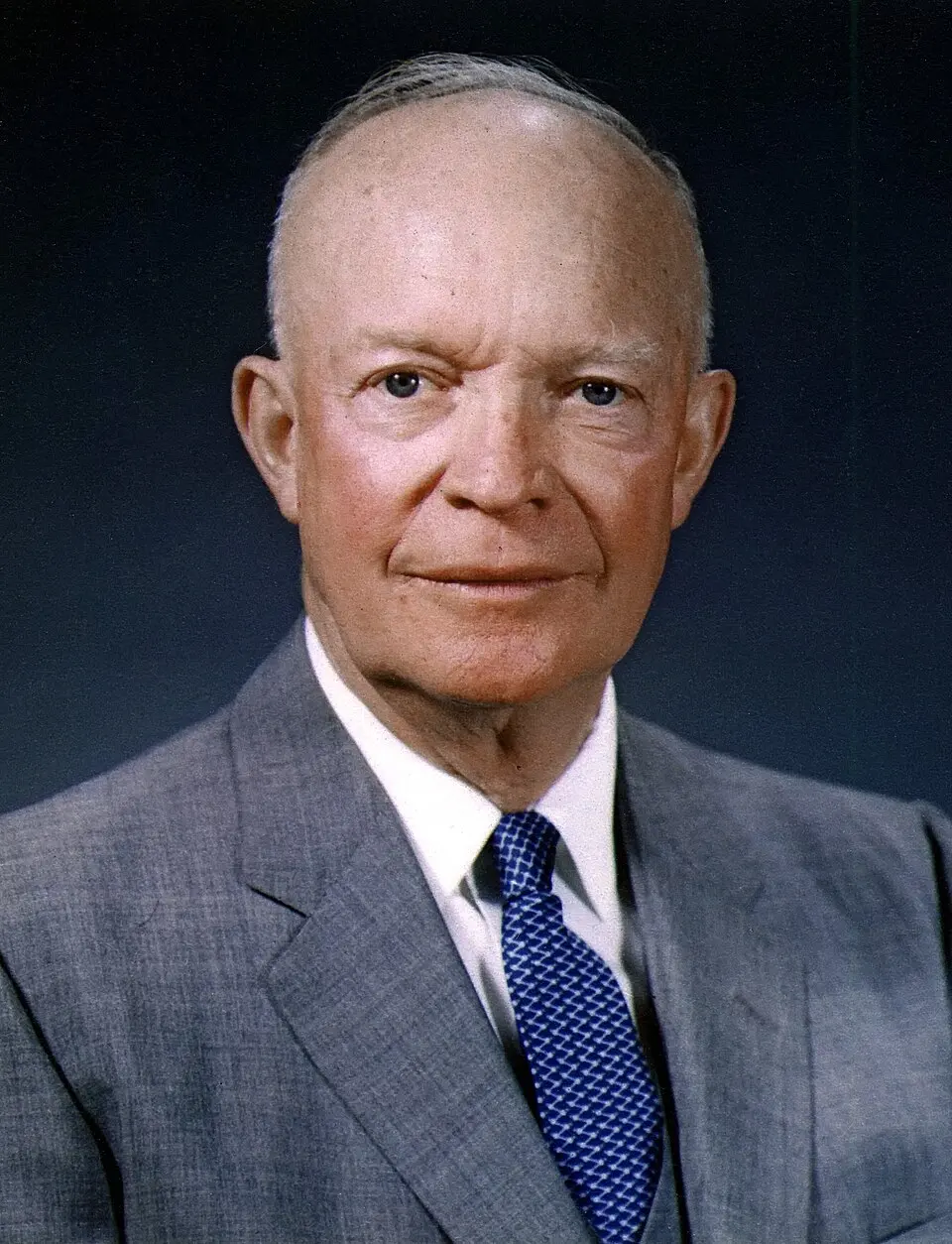
Portrait of Dwight D. Eisenhower
Dwight D. Eisenhower, May 29, 1959Photo: The White House, Eisenhower Presidential LibraryPublic domainSource of this photograph (opens in a new tab)
Born
October 14, 1890Denison, Texas
Died
March 28, 1969
Home state
Kansas
Vice president
Richard Nixon

Life & Offices

Raised in Abilene, Kansas, Eisenhower graduated from West Point in 1915 and spent the years between the world wars in staff posts under generals including John J. Pershing and Douglas MacArthur. In World War II he commanded the Allied invasions of North Africa, Sicily and Italy, then, as supreme commander, the Normandy landings of June 6, 1944, and the campaign that ended with Germany’s surrender in May 1945.

Courted by both parties, Eisenhower sought the 1952 Republican nomination, defeated Senator Robert A. Taft for it and won the presidency decisively over Adlai Stevenson, ending twenty years of Democratic control of the White House. He called his approach “modern Republicanism”: he accepted the core of the New Deal and expanded Social Security while pressing for restraint in federal spending, and his administration produced budget surpluses in three years.

Abroad, he secured an armistice in Korea in July 1953 and pursued containment of the Soviet Union while relying on nuclear deterrence and covert action to hold down costs. At home he signed the law creating the Interstate Highway System, sent federal troops to enforce desegregation at Little Rock Central High School in 1957, and signed the first civil rights laws since Reconstruction. His Farewell Address of January 1961 warned against “the acquisition of unwarranted influence” by “the military-industrial complex.”

Offices before the presidency

  • Supreme Commander, Allied Expeditionary Force (1943–1945)
  • Chief of Staff of the U.S. Army (1945–1948)
  • President of Columbia University (1948–1953)
  • Supreme Allied Commander Europe, NATO (1951–1952)

Era: VI. Eisenhower and the Cold War

The Record

  • 1953

    Korean War armistice

    Eisenhower visited Korea before taking office and pressed for a settlement. The armistice signed July 27, 1953, ended the fighting along a line near the 38th parallel.

    Historical Record
  • 1953

    Atoms for Peace

    Before the United Nations General Assembly on December 8, 1953, Eisenhower proposed an international agency to promote peaceful uses of atomic energy, leading to the creation of the International Atomic Energy Agency in 1957.

    Primary Source
  • 1954–1956

    “Under God” and the national motto

    Eisenhower signed laws adding the words “under God” to the Pledge of Allegiance in 1954 and making “In God We Trust” the national motto in 1956.

    Historical Record
  • 1956

    Interstate Highway System

    The Federal-Aid Highway Act of June 29, 1956, authorized a 41,000-mile National System of Interstate and Defense Highways, financed largely through a federal Highway Trust Fund.

    Primary Source
  • 1957

    Little Rock Central High School

    After Arkansas Governor Orval Faubus used the state National Guard to keep nine Black students out of Central High School, and a mob later besieged the school, Eisenhower issued Executive Order 10730, federalized the Arkansas National Guard and sent the 101st Airborne Division to protect the students.

    Primary Source
  • 1957–1960

    Civil Rights Acts of 1957 and 1960

    The first federal civil rights laws since Reconstruction created the U.S. Commission on Civil Rights and a Civil Rights Division in the Justice Department, and strengthened federal authority to protect voting rights through lawsuits and court-appointed referees.

    Historical Record
  • 1958

    Space and science after Sputnik

    After the Soviet Union launched Sputnik in October 1957, Eisenhower signed laws creating the National Aeronautics and Space Administration and the National Defense Education Act, which funded science, mathematics and foreign-language instruction.

    Historical Record
  • 1959

    Alaska and Hawaii statehood

    Alaska became the 49th state in January 1959 and Hawaii the 50th in August 1959.

    Historical Record
  • 1961

    Farewell Address

    In his televised farewell on January 17, 1961, Eisenhower warned that a permanent arms industry and a vast military establishment, however necessary, must not be allowed to endanger liberty or democratic processes.

    Primary Source

Criticism & Debate

Opposing View / Debate

Was Eisenhower too cautious on civil rights?

Eisenhower appointed Earl Warren as chief justice in 1953, and the Warren Court decided Brown v. Board of Education the next year. Eisenhower enforced federal court orders at Little Rock and signed two civil rights acts, but he never publicly endorsed the reasoning of the Brown decision.

Critics

Civil rights leaders and many historians fault Eisenhower for withholding moral leadership when the nation needed it and for acting at Little Rock only after open defiance of federal authority.

Defenders

Defenders point to his appointment of Warren and of federal judges in the South who enforced desegregation, the completion of military desegregation, the desegregation of public facilities in Washington, D.C., the 1957 and 1960 Civil Rights Acts, and his decision to send paratroopers to Little Rock.

Sources

  1. Dwight D. Eisenhower: Domestic Affairs · Miller Center, University of Virginia
Opposing View / Debate

Did covert action serve American interests?

Eisenhower relied on the Central Intelligence Agency to counter Soviet influence at low cost. The agency helped overthrow the governments of Iran in 1953 and Guatemala in 1954, and its U-2 spy flights over the Soviet Union became public when one was shot down in May 1960.

Supporters

Supporters argue that covert operations checked communist gains without large wars, and that Eisenhower kept the country at peace after Korea while declining to intervene militarily in Indochina in 1954.

Critics

Critics argue that overthrowing elected or nationalist governments bred lasting resentment, in Iran especially, and that the U-2 incident, which the administration first tried to explain with a cover story, wrecked the 1960 Paris summit and damaged public trust.

Sources

  1. Dwight D. Eisenhower: Foreign Affairs · Miller Center, University of Virginia

Documents

Sources

  1. Dwight D. Eisenhower · Miller Center, University of Virginia
  2. Dwight D. Eisenhower · White House Historical Association
  3. Dwight D. Eisenhower: Presidential Documents · The American Presidency Project, UC Santa Barbara
  4. Dwight D. Eisenhower Presidential Library, Museum and Boyhood Home · National Archives
  5. Eisenhower National Historic Site · National Park Service