19th President · 1877–1881

Rutherford B. Hayes

A reform-minded Union veteran who won the disputed election of 1876 and presided over the end of Reconstruction.

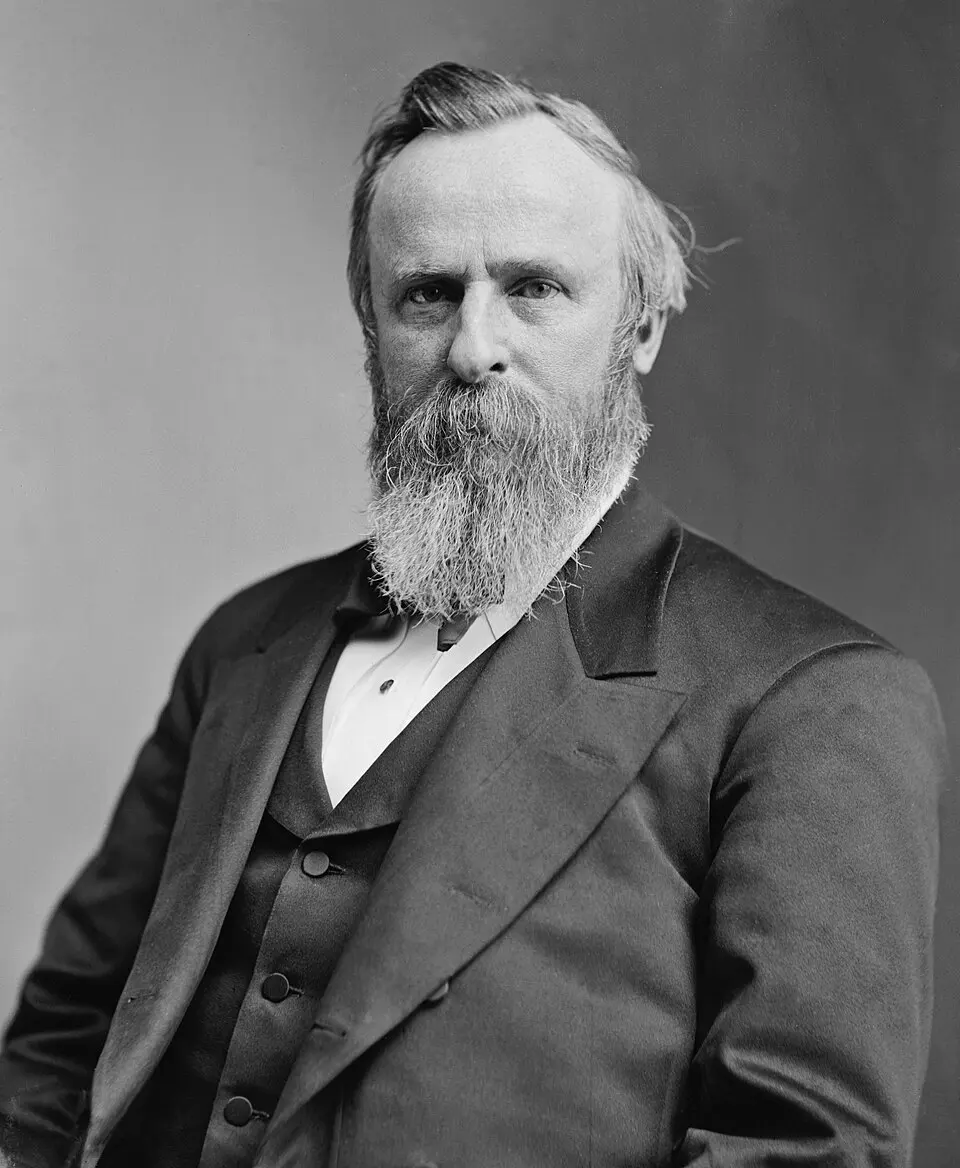
Portrait of Rutherford B. Hayes
Rutherford B. Hayes, c. 1870–1880Photo: Mathew B. Brady, Library of CongressPublic domainSource of this photograph (opens in a new tab)
Born
October 4, 1822Delaware, Ohio
Died
January 17, 1893
Home state
Ohio
Vice president
William A. Wheeler

Life & Offices

Hayes practiced law in Cincinnati, where he defended people who had escaped slavery, and joined the new Republican Party in the 1850s. Wounded several times as a Union officer, he was elected to Congress in 1864 while still in the field and later served three terms as governor of Ohio, earning a reputation for honesty and support for civil service reform.

The election of 1876 produced the most bitterly disputed result in American history to that time. Democrat Samuel J. Tilden won the popular vote, but returns from Florida, Louisiana and South Carolina, along with one Oregon elector, were contested. Congress created a fifteen-member Electoral Commission, which voted 8 to 7 along party lines to award every disputed vote to Hayes, giving him a 185–184 majority in the Electoral College days before the inauguration.

Southern Democrats acquiesced amid understandings that the new administration would withdraw the last federal troops protecting Republican state governments in the South. In April 1877 Hayes ordered troops away from the statehouses in Columbia and New Orleans, and those governments fell. Having pledged to serve a single term, Hayes pressed civil service reform, sent federal troops at governors’ request during the Great Railroad Strike of 1877, and repeatedly vetoed Democratic efforts to strip federal protection from elections.

Offices before the presidency

  • City solicitor of Cincinnati (1857–1859)
  • Union Army officer; brevetted major general (1861–1865)
  • U.S. House of Representatives, Ohio (1865–1867)
  • Governor of Ohio (1868–1872, 1876–1877)

Eras: II. Union, Emancipation and Reconstruction · III. Industrial America

The Record

  • 1877

    Electoral Commission decision

    Under the Electoral Commission Act of January 1877, a panel of five senators, five representatives and five Supreme Court justices resolved the disputed returns. Its party-line rulings made Hayes president by a single electoral vote.

    Historical Record
  • 1877

    Withdrawal of federal troops from Southern statehouses

    In April 1877 Hayes ordered the federal troops guarding the Republican claimants to power in South Carolina and Louisiana back to their barracks. Democratic governments took control of both states, and Reconstruction as a federal project came to an end.

    Historical Record
  • 1877–1878

    Civil service reform

    Hayes barred federal officeholders from managing political organizations and campaigns by executive order in June 1877 and, over the objections of New York Senator Roscoe Conkling, removed Chester A. Arthur as collector of the Port of New York in 1878.

    Historical Record
  • 1877

    Great Railroad Strike

    When wage cuts set off a strike that spread along the nation’s rail lines in July 1877, Hayes sent federal troops at the request of state governors to restore order — a precedent for federal intervention in labor disputes.

    Historical Record
  • 1878–1879

    Bland–Allison veto and the return to gold

    Hayes vetoed the Bland–Allison silver coinage bill, which Congress passed over his veto in 1878. The Treasury nevertheless resumed redeeming greenbacks in gold on January 1, 1879.

    Historical Record
  • 1879

    Vetoes defending federal election laws

    When the Democratic Congress attached riders to appropriation bills barring troops and federal marshals from polling places, Hayes vetoed the measures repeatedly, arguing that Congress could not use appropriations to force the president to abandon the election laws.

    Historical Record
  • 1879

    Veto of a Chinese exclusion bill

    Hayes vetoed a bill limiting the number of Chinese passengers on arriving ships because it violated the Burlingame Treaty of 1868. His administration instead negotiated the Angell Treaty of 1880, which allowed the United States to regulate or suspend, but not absolutely prohibit, the immigration of Chinese laborers.

    Historical Record

Criticism & Debate

Opposing View / Debate

Did the settlement of 1877 abandon Black Southerners?

Hayes took office after negotiations in which Southern Democrats accepted his victory and the new administration withdrew federal troops from the last Reconstruction statehouses. Historians have long called the arrangement the Compromise of 1877, though they disagree about how formal the bargain was.

Critics

Many historians, and Black leaders of the time, regard the withdrawal as the moment the federal government abandoned freedpeople to disfranchisement and violence. Within a generation Southern states had largely eliminated Black voting.

Hayes and his defenders

Hayes believed military occupation had lost Northern support and could not be sustained by a small army that the Democratic House was unwilling to fund. He sought pledges from Southern Democrats to respect Black citizens’ rights and later vetoed attempts to repeal federal election protections.

Scholarly debate

C. Vann Woodward’s 1951 study Reunion and Reaction argued that a detailed economic bargain decided the outcome. Later historians contend that no single deal was decisive and that Northern retreat from Reconstruction was already well advanced.

Sources

  1. Rutherford B. Hayes: Campaigns and Elections · Miller Center, University of Virginia

Documents

  • March 5, 1877

    Inaugural Address

    Held by Rutherford B. Hayes Presidential Library & Museums

    Hayes proposed a single six-year presidential term and declared that a president “serves his party best who serves the country best.”

    Primary Source
  • March 19, 1879

    Special Session Message

    Held by National Archives

    Hayes’s message convening Congress after appropriations failed in the dispute over federal election laws.

    Primary Source

Sources

  1. Rutherford B. Hayes · Miller Center, University of Virginia
  2. Rutherford B. Hayes · White House Historical Association
  3. Rutherford B. Hayes: Presidential Documents · The American Presidency Project, UC Santa Barbara
  4. HAYES, Rutherford Birchard · U.S. House of Representatives: History, Art & Archives