18th President · 1869–1877

Ulysses S. Grant

The Union’s victorious general, who as president enforced Reconstruction and the Fifteenth Amendment while his administration was shadowed by scandal.

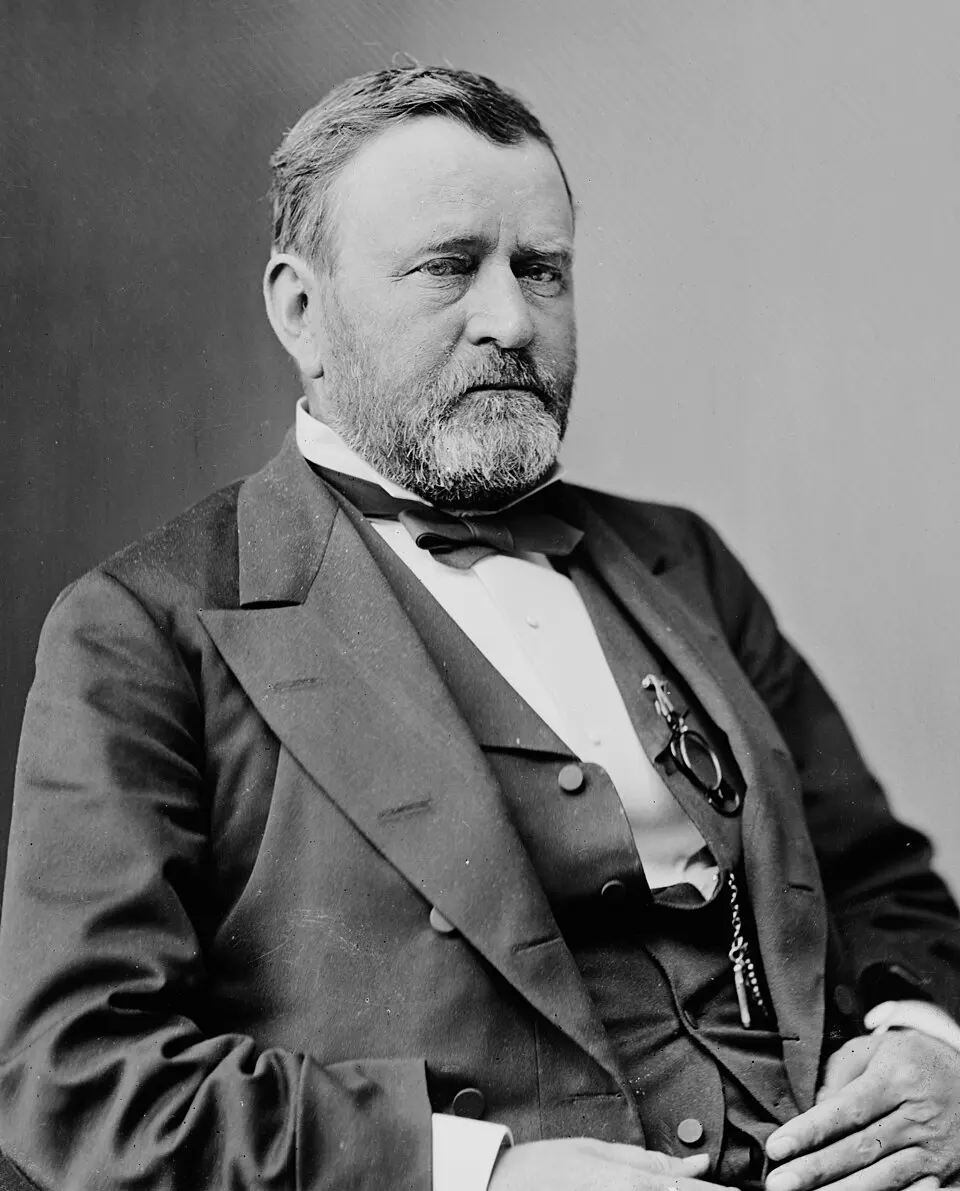
Portrait of Ulysses S. Grant
Ulysses S. Grant, c. 1870–1880Photo: Brady-Handy Collection, Library of CongressPublic domainSource of this photograph (opens in a new tab)
Born
April 27, 1822Point Pleasant, Ohio
Died
July 23, 1885
Home state
Illinois
Vice presidents
Schuyler Colfax, Henry Wilson

Life & Offices

Born Hiram Ulysses Grant in southern Ohio, Grant graduated from West Point in 1843, served with distinction in the Mexican War and resigned from the Army in 1854. When the Civil War began he was working in his family’s leather goods store in Galena, Illinois. Victories at Forts Henry and Donelson, Vicksburg and Chattanooga brought him command of all Union armies in 1864, and on April 9, 1865, he accepted Robert E. Lee’s surrender at Appomattox Court House.

Elected in 1868 on the slogan “Let us have peace,” Grant took office as the Fifteenth Amendment was moving through the states. He urged its ratification, supported the creation of the Department of Justice, and signed the Enforcement Acts of 1870–1871, which his attorneys general used to prosecute the Ku Klux Klan. In 1871 he suspended habeas corpus in nine South Carolina counties to break the Klan’s hold there.

His two terms also brought the Treaty of Washington and the peaceful arbitration of the Alabama claims with Britain, the first national park at Yellowstone and a commitment to repay the war debt in gold. They were marred by scandals involving appointees and associates, including the Whiskey Ring and the impeachment of Secretary of War William Belknap, though Grant was not shown to have profited personally. After leaving office he wrote his celebrated Personal Memoirs while dying of throat cancer, finishing them days before his death in 1885.

Offices before the presidency

  • Commanding General of the U.S. Army (1864–1869)
  • Secretary of War ad interim (1867–1868)

Era: II. Union, Emancipation and Reconstruction

The Record

  • 1870

    Department of Justice

    Congress created the Department of Justice in June 1870, placing the attorney general at the head of a federal department with a new solicitor general. Under Attorney General Amos Akerman it became the chief instrument for enforcing civil rights laws in the South.

    Historical Record
  • 1870

    Fifteenth Amendment

    Ratified in February 1870, the amendment barred the federal and state governments from denying the vote on account of race, color or previous condition of servitude. Grant marked its adoption with a special message to Congress calling it “the most important event that has occurred since the nation came into life.”

    Historical Record
  • 1870–1871

    Enforcement Acts and the Ku Klux Klan Act

    A series of laws made interference with voting a federal crime, and the Ku Klux Klan Act of April 1871 authorized the president to use the military and suspend habeas corpus against conspiracies to deny citizens their rights. Federal prosecutions in 1871 and 1872 sharply weakened the original Klan.

    Historical Record
  • 1871

    Treaty of Washington

    The treaty with Great Britain settled fishing and boundary disputes and sent the Alabama claims — damages caused by British-built Confederate raiders — to an international tribunal in Geneva, which in 1872 awarded the United States $15.5 million.

    Historical Record
  • 1872

    Yellowstone National Park

    Grant signed the act of March 1, 1872, setting aside Yellowstone “as a public park or pleasuring-ground for the benefit and enjoyment of the people” — the world’s first national park.

    Primary Source
  • 1869–1876

    Peace Policy and Ely S. Parker

    Grant announced a “Peace Policy” toward Native nations that relied on religious denominations to staff Indian agencies, and he appointed his former aide Ely S. Parker, a Seneca, as the first Native American commissioner of Indian affairs. The policy did not prevent renewed warfare on the Plains, including the Great Sioux War of 1876–1877.

    Historical Record
  • 1869–1875

    Hard money

    Grant signed the Public Credit Act pledging repayment of the war debt in gold, vetoed an 1874 bill to expand the paper currency, and signed the Specie Payment Resumption Act of 1875, which returned the country to gold convertibility in 1879.

    Historical Record
  • 1875

    Civil Rights Act of 1875

    Grant signed the act guaranteeing equal access to public accommodations regardless of race, the last major civil rights law of Reconstruction. The Supreme Court struck down its key provisions in the Civil Rights Cases of 1883.

    Historical Record

Criticism & Debate

Opposing View / Debate

Should Grant’s presidency be judged by its scandals or by its defense of civil rights?

For much of the twentieth century Grant ranked near the bottom of presidential surveys, remembered for the corruption of associates and appointees: the 1869 attempt by speculators Jay Gould and James Fisk to corner the gold market, the Whiskey Ring tax fraud, and the impeachment of Secretary of War William Belknap. Since the late twentieth century many historians have reassessed his record on Reconstruction, and his standing has risen.

Critics

Contemporaries, including the Liberal Republicans who opposed his reelection in 1872, charged that Grant tolerated cronyism, defended associates such as his private secretary Orville Babcock, who was indicted in the Whiskey Ring, and resisted meaningful civil service reform.

Reassessment

Recent biographers emphasize that Grant was not shown to have profited from any scandal, that he encouraged Treasury Secretary Benjamin Bristow’s prosecution of the Whiskey Ring, and that his enforcement of civil and voting rights in the South was the most vigorous of any nineteenth-century president.

Sources

  1. Ulysses S. Grant: Domestic Affairs · Miller Center, University of Virginia
Opposing View / Debate

Did Grant do enough to sustain Reconstruction?

Federal enforcement peaked in 1871–1872. After Democrats won the House in the 1874 elections and the Supreme Court narrowed federal authority in cases such as United States v. Cruikshank (1876), the administration intervened less often. In 1875 it declined Mississippi Governor Adelbert Ames’s request for troops as white Democrats used violence and intimidation to retake the state.

Grant’s defenders

Defenders point to the political limits Grant faced: a Northern public tiring of intervention, a Democratic House after 1874, a small army and adverse court rulings.

Critics

Critics argue that retreating from enforcement signaled to white supremacist paramilitary groups that federal protection would not come, hastening the collapse of Republican governments across the South.

Documents

Sources

  1. Ulysses S. Grant · Miller Center, University of Virginia
  2. Ulysses S. Grant · White House Historical Association
  3. Ulysses S. Grant: Presidential Documents · The American Presidency Project, UC Santa Barbara
  4. Ulysses S. Grant National Historic Site · National Park Service