16th President · 1861–1865

Abraham Lincoln

The first Republican president, who led the Union through the Civil War, issued the Emancipation Proclamation and pressed the Thirteenth Amendment through Congress.

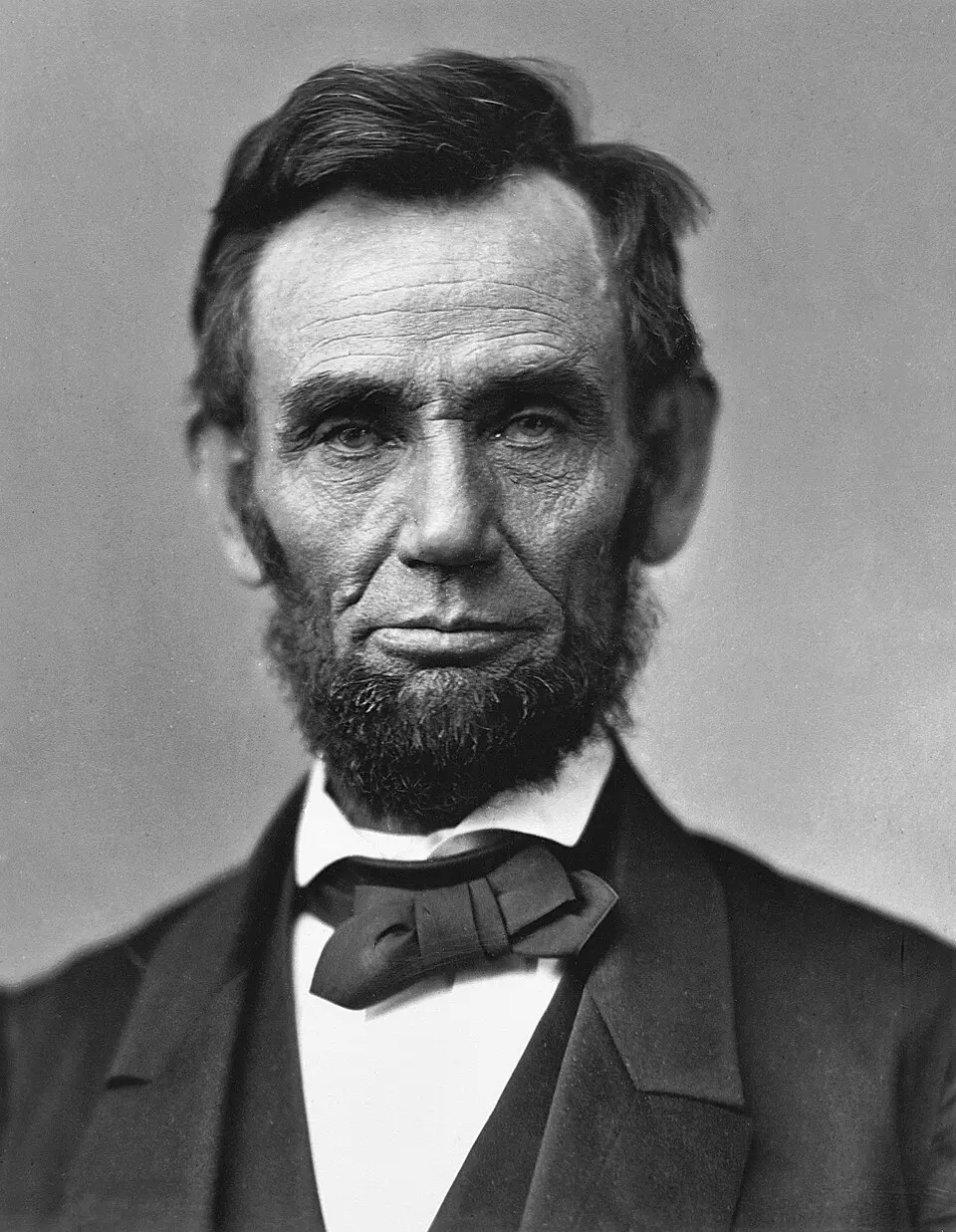
Portrait of Abraham Lincoln
Abraham Lincoln, November 8, 1863Photo: Alexander GardnerPublic domainSource of this photograph (opens in a new tab)
Born
February 12, 1809Hardin County (now LaRue County), Kentucky
Died
April 15, 1865
Home state
Illinois
Vice presidents
Hannibal Hamlin, Andrew Johnson

Life & Offices

Born in a log cabin in Kentucky and raised on the Indiana and Illinois frontier, Lincoln had less than a year of formal schooling. He taught himself law, served four terms in the Illinois legislature as a Whig and one term in Congress, where he opposed the Mexican War. The Kansas–Nebraska Act of 1854, which opened western territories to slavery, drew him back into politics and into the new Republican Party. His 1858 Senate race against Stephen A. Douglas, which he lost, made him a national figure, and in 1860 he won the presidency without carrying a single slave state.

Seven states had seceded by the time of his inauguration, and four more left after Confederate forces fired on Fort Sumter in April 1861. Lincoln held that secession was illegal and that the war was a test of whether popular government could survive. As commander in chief he expanded the war powers of the presidency, searched for effective generals until he turned to Ulysses S. Grant, and in 1863 made emancipation a war aim. With the Republican Congress he also enacted a lasting domestic program: the Homestead Act, land-grant colleges, the Pacific Railway Act, a national banking system and the Department of Agriculture.

Reelected in 1864 on a National Union ticket with War Democrat Andrew Johnson, Lincoln pressed the House to approve the Thirteenth Amendment abolishing slavery, which it did in January 1865. His Second Inaugural Address, delivered as the war neared its end, called on Americans to proceed “with malice toward none, with charity for all.” On April 14, 1865, five days after Robert E. Lee’s surrender at Appomattox, John Wilkes Booth shot him at Ford’s Theatre. He died the next morning, the first American president to be assassinated.

Offices before the presidency

  • Captain of an Illinois volunteer company in the Black Hawk War (1832)
  • Postmaster of New Salem, Illinois (1833–1836)
  • Illinois House of Representatives (1834–1842)
  • U.S. House of Representatives, Illinois (1847–1849)

Eras: I. Formation · II. Union, Emancipation and Reconstruction

The Record

  • 1861–1865

    Preserving the Union

    Lincoln refused to recognize secession, called for volunteers after the fall of Fort Sumter and directed the Union war effort as commander in chief. He kept the border slave states of Delaware, Maryland, Kentucky and Missouri in the Union, and by the spring of 1865 the principal Confederate armies had surrendered.

    Historical Record
  • 1861–1864

    Financing the war

    Lincoln and Congress enacted the first federal income tax, issued paper “greenback” currency as legal tender and created a system of nationally chartered banks under the National Banking Acts of 1863 and 1864.

    Historical Record
  • 1862

    Homestead Act

    Signed May 20, 1862, the act offered 160 acres of surveyed public land to any adult citizen, or immigrant intending to become one, who had never taken up arms against the United States and who lived on and improved the claim for five years. It became one of the largest transfers of public land to private owners in the nation’s history.

    Primary Source
  • 1862

    Pacific Railway Act

    Signed July 1, 1862, the act chartered the Union Pacific Railroad and backed a railroad and telegraph line to the Pacific with land grants and government bonds. The first transcontinental line was completed at Promontory Summit, Utah Territory, in May 1869.

    Primary Source
  • 1862

    Morrill Land-Grant College Act

    Signed July 2, 1862, the act granted federal land to the states to endow colleges teaching agriculture and the mechanic arts alongside scientific and classical studies — the origin of the land-grant university system.

    Primary Source
  • 1862–1863

    Emancipation Proclamation

    After a preliminary proclamation on September 22, 1862, Lincoln declared on January 1, 1863, that all persons held as slaves in areas still in rebellion “are, and henceforward shall be free.” Issued under his war powers, it also opened the Union Army and Navy to Black men, nearly 200,000 of whom served before the war ended.

    Primary Source
  • 1863

    Gettysburg Address

    Dedicating the Soldiers’ National Cemetery at Gettysburg on November 19, 1863, Lincoln spoke for about two minutes, calling for “a new birth of freedom” so that “government of the people, by the people, for the people, shall not perish from the earth.”

    Primary Source
  • 1864–1865

    Thirteenth Amendment

    Lincoln made a constitutional ban on slavery part of his 1864 platform and lobbied the House, which approved the amendment on January 31, 1865. He signed the joint resolution the next day, though a president’s signature is not required. The amendment was ratified in December 1865, after his death.

    Historical Record

Criticism & Debate

Opposing View / Debate

Were Lincoln’s wartime limits on civil liberties justified?

In April 1861, with Washington cut off by rioting and sabotage in Maryland, Lincoln authorized military commanders to suspend the writ of habeas corpus along the rail line between Philadelphia and Washington. Suspensions later widened, and thousands of civilians were detained without trial. Chief Justice Roger Taney ruled in Ex parte Merryman (1861) that only Congress could suspend the writ. Congress authorized suspension in 1863, and in Ex parte Milligan (1866) the Supreme Court held that civilians could not be tried by military commissions where civilian courts were open.

Lincoln and his defenders

In his July 4, 1861, message to Congress, Lincoln argued that the Constitution permits suspension “in cases of rebellion or invasion” and asked whether all the laws but one should go unexecuted, and the government itself fall, lest that one be violated. Defenders stress the emergency — a capital surrounded by slave states — and note that elections, including the 1864 presidential race, went forward.

Critics

Taney and many Democrats argued that the power to suspend the writ belongs to Congress under Article I and that military arrests of civilians — including the 1863 arrest and military trial of Ohio Democrat Clement Vallandigham for an antiwar speech — threatened the liberties the war was meant to preserve.

Sources

  1. Special Session Message, July 4, 1861 · The American Presidency Project, UC Santa Barbara
Opposing View / Debate

Did Lincoln move too slowly on emancipation?

Lincoln entered office pledging not to interfere with slavery in the states where it existed, and in 1862 he still promoted gradual, compensated emancipation and the voluntary colonization of freed people abroad. Within three years he had issued the Emancipation Proclamation, enlisted Black soldiers and pressed for a constitutional amendment ending slavery everywhere.

Abolitionist critics

Frederick Douglass, Radical Republicans and other abolitionists urged Lincoln to act sooner. They criticized his revocation of emancipation orders issued by Generals John C. Frémont and David Hunter, objected to his colonization proposals, and noted that the Proclamation exempted the loyal border states and Union-held areas of the South.

Lincoln’s defenders

Many historians argue that Lincoln moved as quickly as he could while holding the border states, sustaining Northern support for the war and acting within his constitutional war powers, and that the sequence he followed — war measure, Black enlistment, constitutional amendment — made emancipation permanent.

Sources

  1. Abraham Lincoln: Domestic Affairs · Miller Center, University of Virginia

Documents

  • March 4, 1861

    First Inaugural Address

    Held by Library of Congress

    Lincoln’s appeal to the seceding states, closing with “the better angels of our nature.”

    Primary Source
  • May 20, 1862

    Homestead Act

    Held by National Archives

    Primary Source
  • January 1, 1863

    Emancipation Proclamation

    Held by National Archives

    Primary Source
  • November 19, 1863

    Gettysburg Address

    Held by Library of Congress

    Two of the five known manuscript copies in Lincoln’s hand are held by the Library of Congress.

    Primary Source
  • March 4, 1865

    Second Inaugural Address

    Held by Library of Congress

    Primary Source

Sources

  1. Abraham Lincoln · Miller Center, University of Virginia
  2. Abraham Lincoln · White House Historical Association
  3. Abraham Lincoln: Presidential Documents · The American Presidency Project, UC Santa Barbara
  4. LINCOLN, Abraham · U.S. House of Representatives: History, Art & Archives
  5. Lincoln Home National Historic Site · National Park Service