26th President · 1901–1909

Theodore Roosevelt

The youngest president, who used the office as a “bully pulpit” to regulate corporations, conserve public lands and project American power abroad.

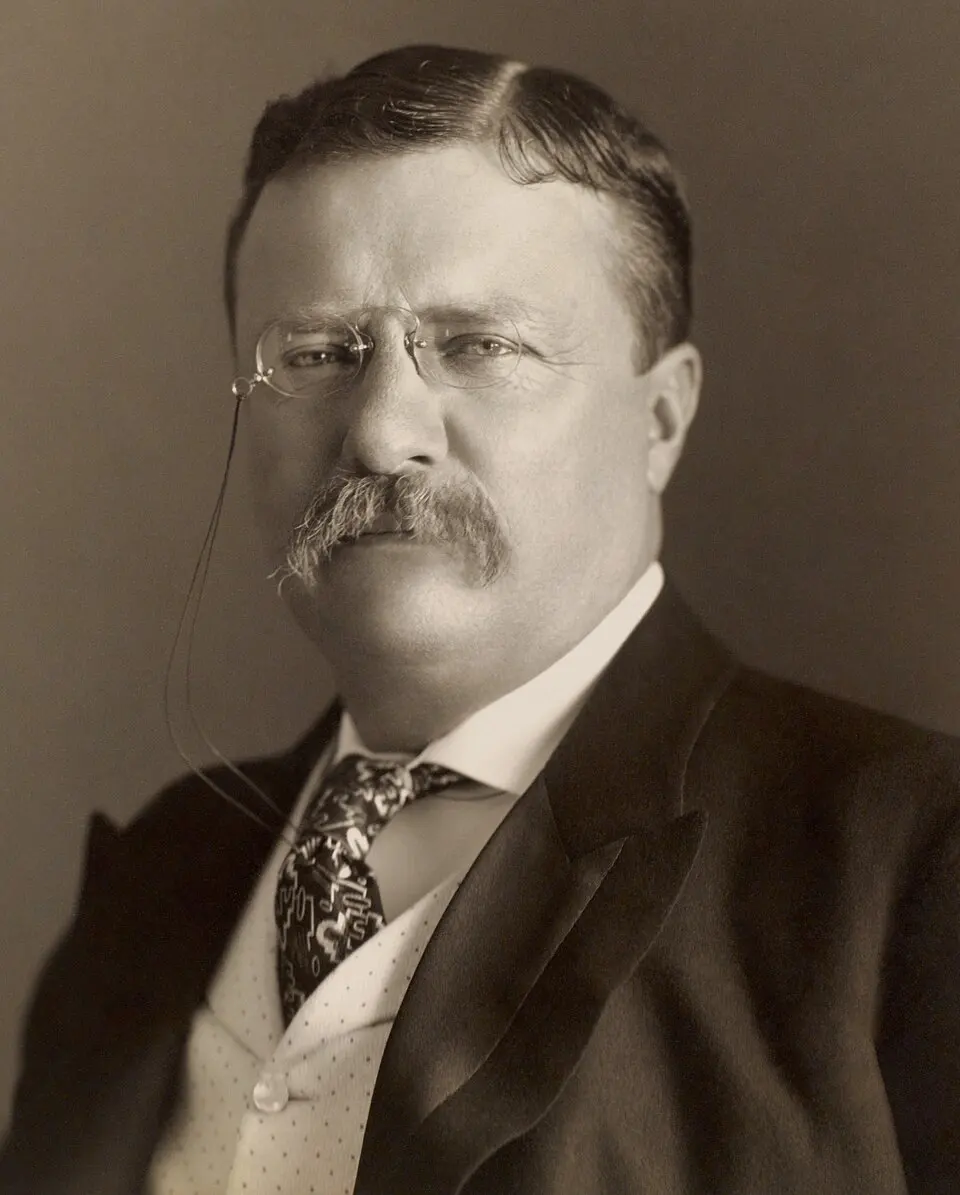
Portrait of Theodore Roosevelt
Theodore Roosevelt, 1904Photo: Pach Brothers, Library of CongressPublic domainSource of this photograph (opens in a new tab)
Born
October 27, 1858New York, New York
Died
January 6, 1919
Home state
New York
Vice president
Charles W. Fairbanks

Life & Offices

A sickly child of a wealthy New York family, Roosevelt built himself up through strenuous exercise, and after his mother and his first wife died on the same day in 1884 he spent long stretches ranching in the Dakota Badlands. He wrote history, served as a reform-minded state legislator, civil service commissioner, New York police commissioner and assistant secretary of the Navy, and became a national hero leading the Rough Riders in Cuba in 1898.

Elected governor of New York and then vice president, Roosevelt became, at forty-two, the youngest person to hold the presidency when McKinley was assassinated in September 1901. He called his program a “Square Deal” for business, labor and consumers: his Justice Department sued to break up the Northern Securities railroad trust, he mediated the 1902 anthracite coal strike, and he won laws regulating railroad rates, meat inspection, and food and drugs.

Roosevelt protected about 230 million acres of public land, secured the rights to build the Panama Canal, sent the Navy’s “Great White Fleet” around the world and won the 1906 Nobel Peace Prize for mediating an end to the Russo-Japanese War. After leaving office he broke with his successor, William Howard Taft, and ran in 1912 as the Progressive (“Bull Moose”) candidate, finishing second and splitting the Republican vote.

Offices before the presidency

  • New York State Assembly (1882–1884)
  • U.S. Civil Service Commission (1889–1895)
  • President of the New York City Board of Police Commissioners (1895–1897)
  • Assistant Secretary of the Navy (1897–1898)
  • Colonel, 1st U.S. Volunteer Cavalry, the “Rough Riders” (1898)
  • Governor of New York (1899–1900)
  • Vice President of the United States (1901)

Era: IV. Roosevelt and Republican Progressivism

The Record

  • 1902–1904

    Northern Securities suit

    Roosevelt’s Justice Department sued to dissolve a railroad holding company formed by J. P. Morgan, James J. Hill and E. H. Harriman. The Supreme Court ordered it broken up in 1904, reviving the Sherman Antitrust Act.

    Historical Record
  • 1902

    Anthracite coal strike

    With a winter fuel shortage looming, Roosevelt brought mine operators and the United Mine Workers to the White House and secured arbitration by a presidential commission — an unprecedented intervention by a president as mediator rather than strikebreaker.

    Historical Record
  • 1903–1904

    Panama Canal

    After Colombia’s senate rejected a canal treaty, Roosevelt backed Panama’s declaration of independence in November 1903 and within weeks concluded the Hay–Bunau-Varilla Treaty granting the United States a canal zone. American construction began in 1904, and the canal opened in 1914.

    Historical Record
  • 1904

    Roosevelt Corollary to the Monroe Doctrine

    In his December 1904 annual message, Roosevelt asserted that “chronic wrongdoing” by a nation in the Western Hemisphere might force the United States, “however reluctantly,” to exercise “an international police power.”

    Primary Source
  • 1906

    Hepburn Act, Meat Inspection Act and Pure Food and Drug Act

    The Hepburn Act empowered the Interstate Commerce Commission to set maximum railroad rates. The same year Roosevelt signed laws requiring federal inspection of meatpacking and banning adulterated or mislabeled food and drugs.

    Historical Record
  • 1901–1909

    Conservation and the Antiquities Act

    Roosevelt created the U.S. Forest Service and, by the National Park Service’s count, established 150 national forests, 51 federal bird reserves, 4 national game preserves, 5 national parks and 18 national monuments — the monuments under the Antiquities Act of 1906 — protecting about 230 million acres.

    Historical Record
  • 1905–1906

    Nobel Peace Prize

    Roosevelt mediated the Treaty of Portsmouth ending the Russo-Japanese War in 1905 and received the Nobel Peace Prize the next year, the first American to win it.

    Historical Record
  • 1907–1909

    The Great White Fleet

    Roosevelt sent sixteen battleships of the Atlantic Fleet on a voyage around the world to display American naval power and goodwill.

    Historical Record

Criticism & Debate

Opposing View / Debate

How far should presidential power reach?

Roosevelt held that a president may do anything the public good requires unless the Constitution or the laws forbid it — his “stewardship” theory of the presidency. His successor, William Howard Taft, answered that a president may exercise only those powers that can be traced to a specific grant in the Constitution or an act of Congress.

Roosevelt’s view

Roosevelt believed an energetic executive was the people’s steward against concentrated private power, and he used executive orders, public appeals and mediation to act where Congress was slow.

Taft’s view

Taft, who later became chief justice, warned that an undefined reservoir of executive power invited abuse, and many conservatives have since shared his concern about presidential overreach.

Opposing View / Debate

Was the Brownsville discharge just?

In August 1906 shots fired in Brownsville, Texas, killed one man and wounded another. White residents blamed Black soldiers of the 25th Infantry stationed nearby. When no soldier admitted involvement or named others, Roosevelt discharged 167 men of three companies without honor, barring them from pensions and future federal service.

Critics

Black leaders, many newspapers and Ohio Republican Senator Joseph Foraker condemned the collective punishment of men who were never charged or tried. In 1972 the Army reversed the discharges.

Roosevelt’s position

Roosevelt maintained that the evidence showed some soldiers had taken part and that the others were shielding them, and he refused to reverse the order.

Documents

Sources

  1. Theodore Roosevelt · Miller Center, University of Virginia
  2. Theodore Roosevelt · White House Historical Association
  3. Theodore Roosevelt: Presidential Documents · The American Presidency Project, UC Santa Barbara
  4. Theodore Roosevelt Birthplace National Historic Site · National Park Service
  5. Sagamore Hill National Historic Site · National Park Service