27th President · 1909–1913

William Howard Taft

A judge by temperament who continued Roosevelt’s trust-busting, split with him over reform, and later became the only person to serve as both president and chief justice.

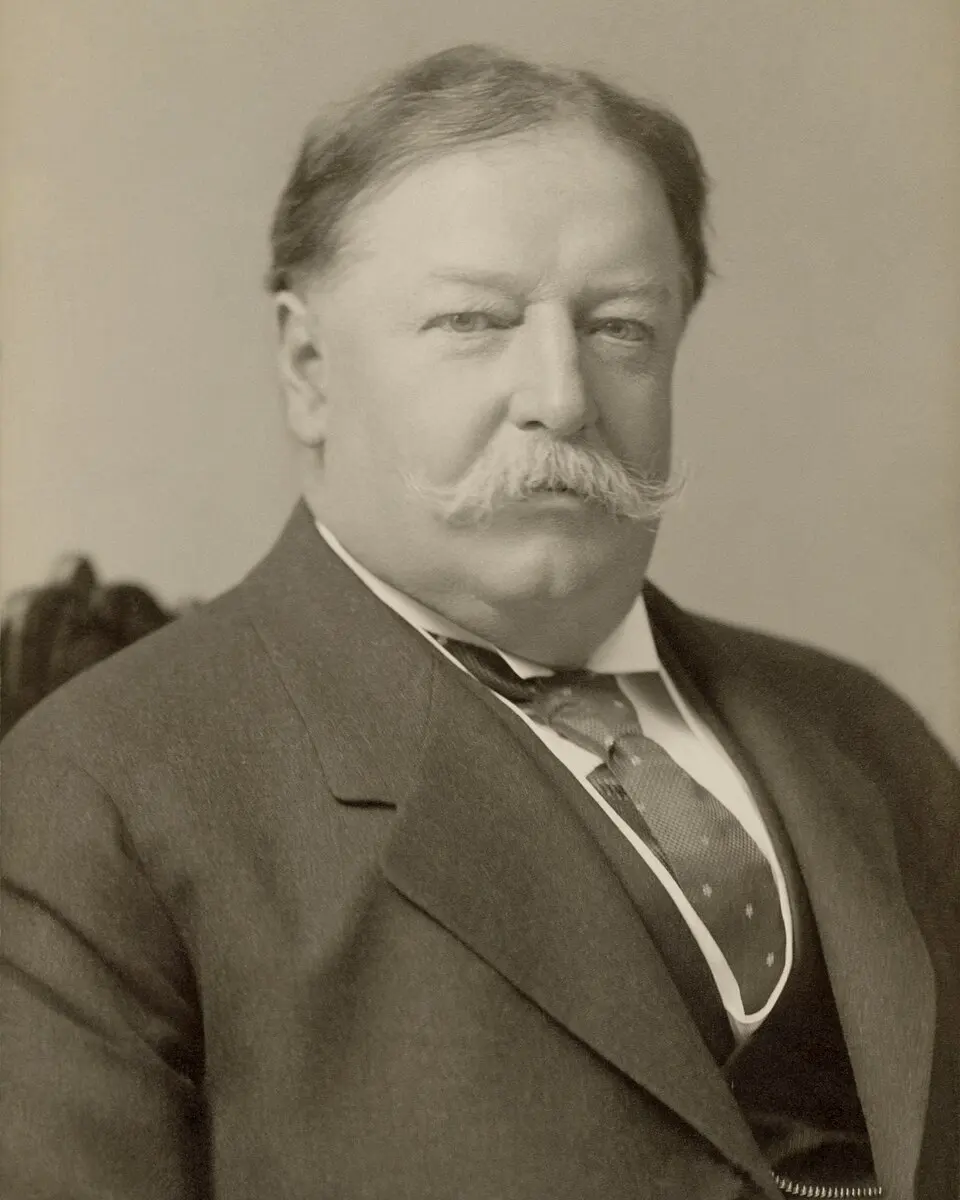
Portrait of William Howard Taft
William Howard Taft, 1908Photo: Pach Brothers, National Portrait GalleryPublic domainSource of this photograph (opens in a new tab)
Born
September 15, 1857Cincinnati, Ohio
Died
March 8, 1930
Home state
Ohio
Vice president
James S. Sherman

Life & Offices

The son of a Cincinnati lawyer who had served as Ulysses S. Grant’s attorney general and secretary of war, Taft preferred the bench to politics. He served as a state and federal judge and as solicitor general before President McKinley sent him to the Philippines to head the civil government. Theodore Roosevelt made him secretary of war and chose him as his successor.

As president, Taft brought more antitrust suits in four years than Roosevelt had in nearly eight, including a 1911 suit against U.S. Steel. He backed the constitutional amendment authorizing a federal income tax, which Congress sent to the states in 1909, and signed laws creating postal savings accounts, parcel post and a separate Department of Labor, the last on his final day in office. But the Payne–Aldrich Tariff of 1909, which lowered rates less than reformers wanted, and his dismissal of chief forester Gifford Pinchot alienated progressive Republicans.

Roosevelt challenged Taft for the 1912 nomination and, when the convention chose Taft, ran as a third-party candidate. Taft carried only Utah and Vermont, and Woodrow Wilson won. In 1921 President Harding appointed Taft chief justice of the United States. As chief justice he lobbied successfully for the Judiciary Act of 1925, which gave the justices control over most of their docket, and championed a separate building for the Court, serving until shortly before his death in 1930.

Offices before the presidency

  • Judge, Superior Court of Cincinnati (1887–1890)
  • Solicitor General of the United States (1890–1892)
  • Judge, U.S. Court of Appeals for the Sixth Circuit (1892–1900)
  • President of the Philippine Commission and civil governor of the Philippines (1900–1903)
  • Secretary of War (1904–1908)

Era: IV. Roosevelt and Republican Progressivism

The Record

  • 1909

    Payne–Aldrich Tariff

    After promising tariff revision, Taft signed a bill that made only modest reductions and then publicly defended it as the best tariff the Republican Party had ever passed, angering Midwestern progressives.

    Historical Record
  • 1909–1913

    Sixteenth and Seventeenth Amendments

    With Taft’s support Congress proposed an amendment authorizing a federal income tax in 1909; it was ratified in February 1913. Congress proposed the direct election of senators in 1912, and that amendment was ratified in April 1913, weeks after Taft left office.

    Historical Record
  • 1909–1910

    Ballinger–Pinchot controversy

    When chief forester Gifford Pinchot publicly accused Interior Secretary Richard Ballinger of favoring private interests in Alaska coal lands, Taft fired Pinchot in January 1910. A congressional inquiry cleared Ballinger, but the episode convinced many conservationists that Taft had abandoned Roosevelt’s policies.

    Historical Record
  • 1910

    Mann–Elkins Act

    The act strengthened the Interstate Commerce Commission’s power to suspend and set railroad rates and extended its authority to telephone and telegraph companies.

    Historical Record
  • 1909–1913

    Antitrust enforcement

    The Supreme Court’s 1911 decisions breaking up Standard Oil and American Tobacco — cases begun under Roosevelt — came during Taft’s term, and his Justice Department filed dozens of new antitrust cases. The 1911 suit against U.S. Steel angered Roosevelt, who had approved one of the acquisitions it challenged.

    Historical Record
  • 1909–1913

    Dollar diplomacy

    Taft and Secretary of State Philander Knox encouraged American investment in Latin America and East Asia as a means of extending U.S. influence, and in 1912 Taft sent Marines to Nicaragua.

    Historical Record
  • 1911–1912

    Arizona and New Mexico statehood

    Taft vetoed Arizona’s admission in 1911 because its constitution allowed voters to recall judges. After Arizona removed the provision, New Mexico and Arizona became states in early 1912, completing the forty-eight contiguous states.

    Historical Record
  • 1910–1913

    Postal savings, parcel post and the Department of Labor

    Taft signed laws establishing postal savings accounts in 1910 and parcel post service in 1912, and on March 4, 1913, the act creating a separate Department of Labor.

    Historical Record

Criticism & Debate

Opposing View / Debate

Who was right in the Taft–Roosevelt split of 1912?

The rupture between the two former allies divided the Republican Party, gave the presidency to Woodrow Wilson and framed a lasting argument over reform, the courts and executive power.

Taft and his supporters

Taft’s defenders point to his strong antitrust record and argue that he pursued reform through law and the courts, rightly resisted Roosevelt’s proposal to let voters recall judicial decisions, and followed party rules when the 1912 convention seated his delegates.

Roosevelt and the Progressives

Progressives argued that Taft had surrendered to the party’s conservative Old Guard on the tariff and conservation, and Roosevelt’s supporters charged that the Republican National Committee unfairly awarded contested delegates to Taft even though Roosevelt had won most of the primaries.

Sources

  1. William Taft: Campaigns and Elections · Miller Center, University of Virginia

Documents

Sources

  1. William Taft · Miller Center, University of Virginia
  2. William Howard Taft · White House Historical Association
  3. William Howard Taft: Presidential Documents · The American Presidency Project, UC Santa Barbara
  4. Taft, William Howard · Federal Judicial Center
  5. William Howard Taft National Historic Site · National Park Service