29th President · 1921–1923

Warren G. Harding

A small-town newspaper publisher who promised a “return to normalcy” after World War I, and whose brief presidency paired lasting reforms with notorious scandals.

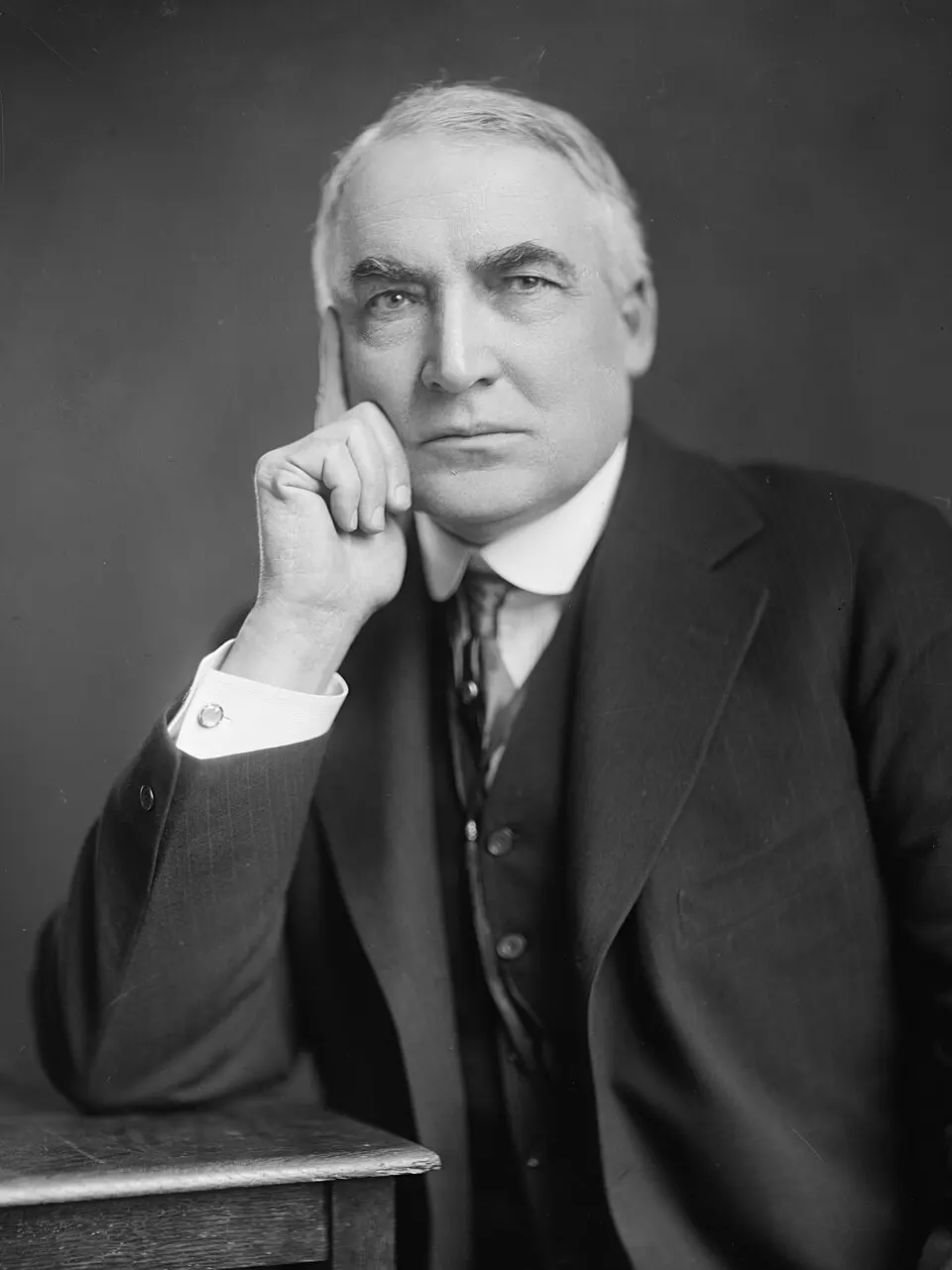
Portrait of Warren G. Harding
Warren G. Harding, c. 1920Photo: Harris & Ewing, Library of CongressPublic domainSource of this photograph (opens in a new tab)
Born
November 2, 1865Blooming Grove, Ohio
Died
August 2, 1923
Home state
Ohio
Vice president
Calvin Coolidge

Life & Offices

Harding built the Marion Star into a successful newspaper and rose through Ohio Republican politics to the U.S. Senate. Nominated as a compromise candidate by a deadlocked 1920 convention, he promised a return to “normalcy” after the war and the bitter fight over the League of Nations, and won the presidency with about 60 percent of the popular vote.

Harding named a cabinet that included Charles Evans Hughes at State, Andrew Mellon at Treasury and Herbert Hoover at Commerce. His administration created the modern federal budget process, convened the Washington Naval Conference, which produced the first major arms limitation agreements among the great powers, and made a separate peace with Germany. He commuted the prison sentence of Socialist leader Eugene V. Debs, and in a 1921 speech in Birmingham, Alabama, called for political and economic equality for Black Americans while rejecting what he called social equality.

Harding died suddenly in San Francisco in August 1923 during a western speaking tour. In the months that followed, congressional investigations exposed corruption among his appointees, including the Teapot Dome oil-lease bribery of Interior Secretary Albert Fall and fraud at the Veterans Bureau. The scandals long dominated his historical reputation.

Offices before the presidency

  • Ohio Senate (1900–1904)
  • Lieutenant Governor of Ohio (1904–1906)
  • U.S. Senate, Ohio (1915–1921)

Era: V. Republicanism Between the World Wars

The Record

  • 1921

    Emergency Quota Act

    Harding signed the first law setting numerical limits on immigration by nationality, capping annual admissions from each country at 3 percent of the number of people born there who were living in the United States at the time of the 1910 census.

    Historical Record
  • 1921

    Call for anti-lynching legislation

    In his first address to Congress, in April 1921, Harding declared that Congress ought to “wipe the stain of barbaric lynching from the banners of a free and orderly, representative democracy.” The Dyer Anti-Lynching Bill he supported passed the House in 1922 but was blocked by a filibuster in the Senate.

    Primary Source
  • 1921

    Budget and Accounting Act

    Signed June 10, 1921, the law required the president to submit a single annual budget to Congress, created the Bureau of the Budget and established the General Accounting Office to audit federal spending.

    Historical Record
  • 1921

    Peace with Germany

    Because the Senate had rejected the Treaty of Versailles, Congress formally ended the war with Germany by joint resolution in July 1921, and the administration concluded the Treaty of Berlin that August.

    Historical Record
  • 1921

    Birmingham address on race

    Speaking in Birmingham, Alabama, in October 1921, Harding said there need be no permanent political or economic differentiation between the races, while rejecting social equality — a speech that drew both praise and angry criticism.

    Primary Source
  • 1921

    Clemency for Eugene V. Debs

    Harding commuted the ten-year sentence of Debs, imprisoned under the Espionage Act for an antiwar speech, along with the sentences of other wartime political prisoners. Debs was released on Christmas Day 1921.

    Historical Record
  • 1921–1922

    Washington Naval Conference

    Secretary of State Hughes opened the conference by proposing deep cuts in battleship fleets. The resulting Five-Power Treaty set limits on the capital ships of the United States, Britain, Japan, France and Italy, and companion treaties addressed the Pacific and China.

    Historical Record
  • 1921–1922

    Tax and tariff policy

    At Treasury Secretary Andrew Mellon’s urging, the Revenue Act of 1921 began reducing wartime income-tax rates, and the Fordney–McCumber Tariff of 1922 restored high protective duties.

    Historical Record

Criticism & Debate

Opposing View / Debate

Do the scandals define Harding’s presidency?

Interior Secretary Albert Fall secretly leased the Teapot Dome naval oil reserve in Wyoming and the Elk Hills reserve in California to oilmen Harry Sinclair and Edward Doheny and received large payments; convicted of bribery in 1929, he became the first cabinet officer to go to prison for crimes committed in office. Veterans Bureau director Charles Forbes was convicted of defrauding the government, and Attorney General Harry Daugherty resigned under pressure in 1924, though two trials ended without a verdict.

Critics

For decades historians ranked Harding among the weakest presidents, faulting him for appointing cronies — the so-called Ohio Gang — and failing to supervise them.

Revisionists

Some historians note that Harding was never shown to have profited from the scandals and point to real achievements: the federal budget system, naval arms limitation, tax reduction, a rapid recovery from the postwar recession, and clemency for Debs and other wartime political prisoners.

Sources

  1. Warren G. Harding: Domestic Affairs · Miller Center, University of Virginia

Documents

Sources

  1. Warren G. Harding · Miller Center, University of Virginia
  2. Warren G. Harding · White House Historical Association
  3. Warren G. Harding: Presidential Documents · The American Presidency Project, UC Santa Barbara
  4. The Washington Naval Conference, 1921–1922 · Office of the Historian, U.S. Department of State