23rd President · 1889–1893

Benjamin Harrison

A grandson of President William Henry Harrison who signed the Sherman Antitrust Act, admitted six western states and backed federal protection of Black voting rights.

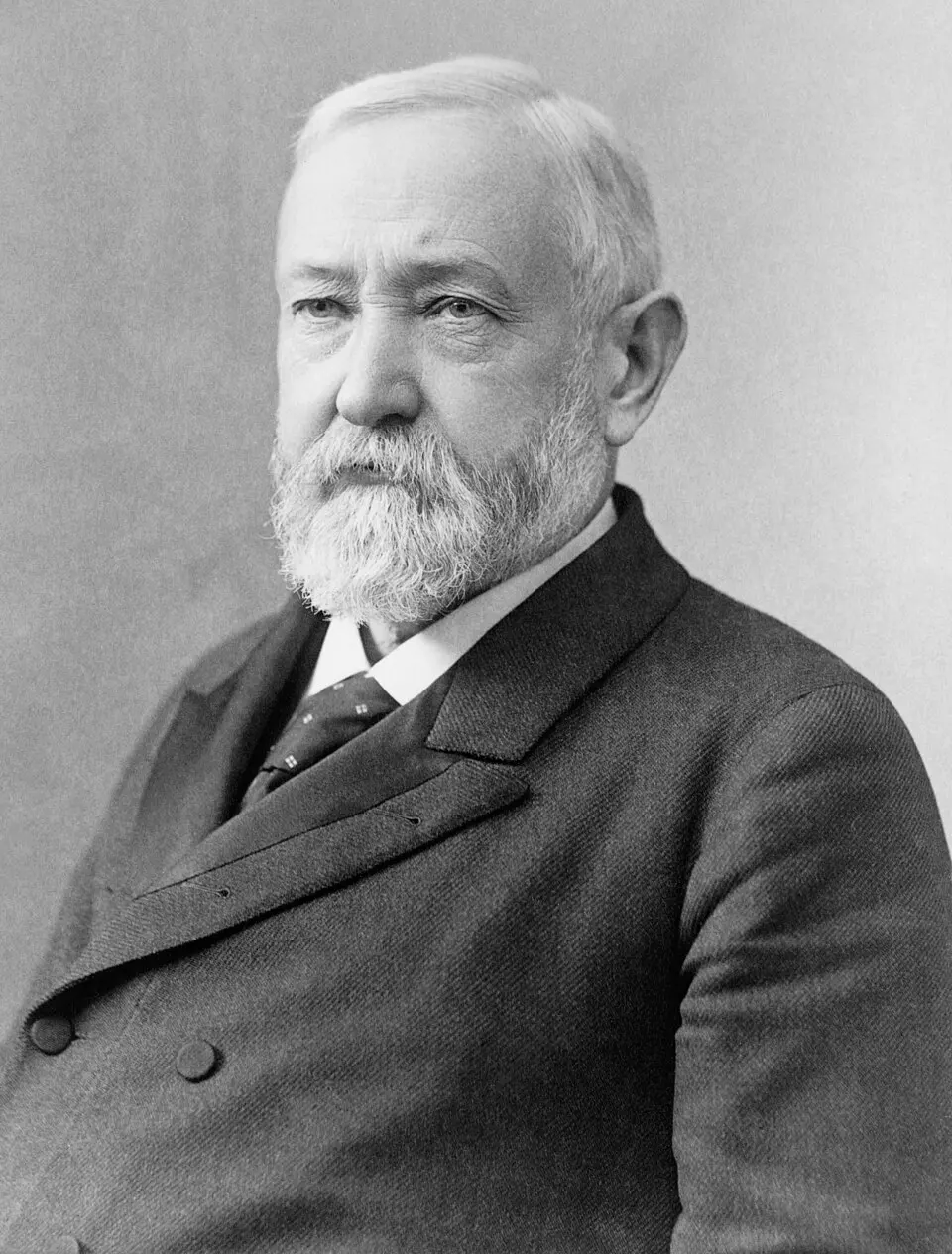
Portrait of Benjamin Harrison
Benjamin Harrison, 1896Photo: Pach Brothers, Library of CongressPublic domainSource of this photograph (opens in a new tab)
Born
August 20, 1833North Bend, Ohio
Died
March 13, 1901
Home state
Indiana
Vice president
Levi P. Morton

Life & Offices

Harrison, a grandson of the ninth president and great-grandson of a signer of the Declaration of Independence, built a law practice in Indianapolis and commanded an Indiana regiment in the Atlanta campaign. After a single term in the Senate he won the 1888 election against President Grover Cleveland, carrying the Electoral College 233 to 168 while narrowly losing the popular vote.

With Republican majorities in both houses, Harrison’s first two years produced one of the most productive Congresses of the century: the Sherman Antitrust Act, the McKinley Tariff, the Sherman Silver Purchase Act and expanded pensions for Union veterans. Critics called it the “Billion-Dollar Congress” for its spending.

Harrison admitted six western states, established the first federal forest reserves and hosted the first International Conference of American States. He also endorsed a federal elections bill to protect Black voters in the South, but it died in the Senate. A backlash against the tariff and federal spending cost Republicans the House in 1890, and Harrison lost a rematch with Cleveland in 1892.

Offices before the presidency

  • Reporter of the Indiana Supreme Court (elected 1860 and 1864)
  • Union Army colonel; brevetted brigadier general (1862–1865)
  • U.S. Senate, Indiana (1881–1887)

Era: III. Industrial America

The Record

  • 1889–1890

    Six new states

    North Dakota, South Dakota, Montana and Washington entered the Union in November 1889, followed by Idaho and Wyoming in July 1890 — more states than were admitted under any other single president.

    Historical Record
  • 1890

    Sherman Antitrust Act

    Passed almost unanimously and signed July 2, 1890, the first federal antitrust law declared illegal every contract, combination or conspiracy in restraint of interstate or foreign trade. Vigorous enforcement came only in the next century.

    Primary Source
  • 1890

    Dependent and Disability Pension Act

    The act extended pensions to Union veterans unable to perform manual labor for any reason, not only for war-related disabilities, and to their widows and minor children, greatly enlarging the pension rolls.

    Historical Record
  • 1890

    Sherman Silver Purchase Act

    A compromise with silver-state Republicans, the act required the Treasury to buy 4.5 million ounces of silver a month with notes redeemable in gold or silver. Its drain on the gold reserve was widely blamed for the Panic of 1893, and it was repealed that year.

    Historical Record
  • 1890–1891

    Federal Elections Bill

    Harrison backed Representative Henry Cabot Lodge’s bill to allow federal supervision of congressional elections where citizens petitioned for it. It passed the House in July 1890 but was set aside in the Senate early in 1891 in the face of a Democratic filibuster.

    Historical Record
  • 1890

    McKinley Tariff

    Named for Representative William McKinley, the law substantially raised protective duties on manufactured goods while authorizing the president to negotiate reciprocal trade agreements.

    Historical Record
  • 1891

    First forest reserves

    Using authority in the Land Revision Act of 1891, Harrison proclaimed the first federal forest reserves, beginning with a reserve next to Yellowstone — the forerunners of today’s national forests.

    Historical Record

Criticism & Debate

Opposing View / Debate

Did the program of 1890 serve the nation or narrow interests?

The Fifty-first Congress enacted the most ambitious Republican program since Reconstruction, and voters sharply rejected it in the 1890 midterm elections.

Supporters

Republicans argued that protective tariffs sheltered American wages and industry, that Union veterans had earned generous pensions, and that the antitrust law and the elections bill showed a willingness to use national power for fair competition and equal rights.

Critics

Democrats and farm-state reformers argued that the McKinley Tariff raised consumer prices, that pension spending had become a political patronage machine and that the Treasury surplus was squandered. The Populist movement grew partly from this discontent.

Sources

  1. Benjamin Harrison: Domestic Affairs · Miller Center, University of Virginia

Documents

Sources

  1. Benjamin Harrison · Miller Center, University of Virginia
  2. Benjamin Harrison · White House Historical Association
  3. Benjamin Harrison: Presidential Documents · The American Presidency Project, UC Santa Barbara
  4. Sherman Anti-Trust Act (1890) · National Archives