21st President · 1881–1885

Chester A. Arthur

A product of New York’s patronage machine who surprised his critics by signing the Pendleton Civil Service Act and beginning the modern steel navy.

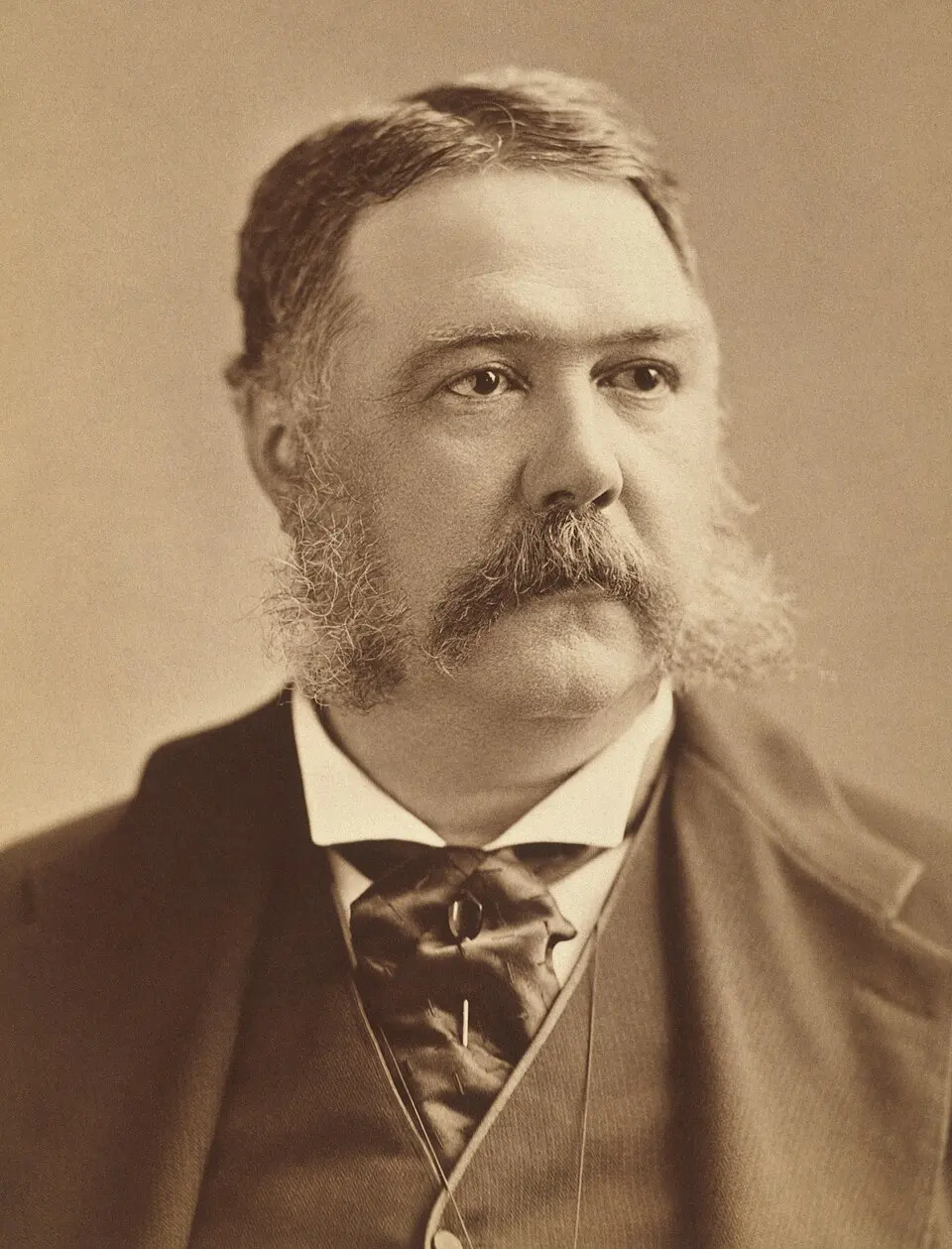
Portrait of Chester A. Arthur
Chester A. Arthur, 1880sPhoto: Abraham Bogardus, National Portrait GalleryPublic domainSource of this photograph (opens in a new tab)
Born
October 5, 1829Fairfield, Vermont
Died
November 18, 1886
Home state
New York
Vice president
None

Life & Offices

The son of an abolitionist Baptist minister, Arthur grew up in Vermont and upstate New York and became a New York City lawyer; in 1855 his firm won a lawsuit on behalf of Elizabeth Jennings, a Black woman forced off a city streetcar. He served as a quartermaster for New York during the Civil War and rose in Senator Roscoe Conkling’s Republican organization, which rewarded him with the lucrative post of collector of the Port of New York until President Hayes removed him in 1878.

Nominated for vice president in 1880 to placate Conkling’s Stalwart faction, Arthur became president when Garfield died in September 1881 — an outcome many reformers dreaded because the assassin had proclaimed himself a Stalwart. Instead Arthur kept his distance from Conkling, signed the Pendleton Civil Service Reform Act in 1883, vetoed a costly rivers-and-harbors bill and pressed Congress to begin building a modern navy of steel warships.

Arthur also signed the Chinese Exclusion Act of 1882 after vetoing an earlier version that would have suspended Chinese labor immigration for twenty years. Privately suffering from Bright’s disease, a then-fatal kidney illness, he made little effort to win renomination in 1884, lost the nomination to James G. Blaine and died in New York City in 1886.

Offices before the presidency

  • Engineer-in-chief and quartermaster general of the New York militia (1861–1862)
  • Collector of the Port of New York (1871–1878)
  • Vice President of the United States (1881)

Era: III. Industrial America

The Record

  • 1882

    Chinese Exclusion Act

    Arthur vetoed a bill suspending Chinese labor immigration for twenty years as inconsistent with the 1880 treaty with China, then signed a ten-year suspension on May 6, 1882. The act, the first federal law to bar immigration by members of a specific nationality, was extended and later made permanent before its repeal in 1943.

    Primary Source
  • 1882

    Veto of the Rivers and Harbors Act

    Arthur vetoed a large public works appropriation that he considered wasteful and too loosely tied to national needs. Congress overrode the veto, but the stand won him credit with reformers.

    Historical Record
  • 1883

    Pendleton Civil Service Reform Act

    Signed January 16, 1883, the act created a bipartisan Civil Service Commission, required competitive examinations for a portion of federal jobs and barred forcing officeholders to make political contributions. It first covered about a tenth of federal positions, and later presidents extended it.

    Primary Source
  • 1883

    Building a steel navy

    At Arthur’s urging, Congress in 1883 authorized the first steel warships of the modern U.S. Navy — the cruisers Atlanta, Boston and Chicago and the dispatch vessel Dolphin.

    Historical Record
  • 1882–1883

    Tariff Commission and the Tariff of 1883

    Arthur supported a tariff commission that recommended substantial rate reductions, but the resulting Tariff of 1883 lowered duties only modestly.

    Historical Record
  • 1882–1883

    Star Route prosecutions

    Arthur’s Justice Department continued prosecuting officials and contractors in the Post Office “star route” frauds, including former political allies, though juries did not convict the principal defendants.

    Historical Record

Criticism & Debate

Opposing View / Debate

How should Americans weigh the Chinese Exclusion Act?

The 1882 law had broad support in both parties, especially in the West, where workers and politicians blamed Chinese laborers for depressing wages. It was renewed and tightened for six decades. In 2011 and 2012 the Senate and the House each adopted resolutions expressing regret for it.

Supporters at the time

Backers, including labor organizations and most western officials, argued that unrestricted Chinese immigration undercut American wages and that the 1880 treaty with China permitted the United States to suspend it.

Opponents then and now

Opponents such as Massachusetts Republican Senator George Frisbie Hoar called exclusion a betrayal of the principle of equal rights. Today the act is widely regarded as the first major federal law to bar immigrants on the basis of race and nationality.

Sources

  1. Chinese Exclusion Act (1882) · National Archives
Opposing View / Debate

Was Arthur’s turn toward reform genuine?

Arthur came to the presidency as a product of the spoils system and left it as the president who signed its first major restriction.

Admirers

Admirers credit Arthur with rising to the office: he broke with Conkling, enforced the new civil service law in good faith and pursued the Star Route prosecutions against former associates.

Skeptics

Skeptics argue that the Pendleton Act was driven by Congress and by public outrage after Garfield’s murder, and that heavy Republican losses in the 1882 elections left Arthur little choice.

Sources

  1. Chester A. Arthur: Domestic Affairs · Miller Center, University of Virginia

Documents

Sources

  1. Chester A. Arthur · Miller Center, University of Virginia
  2. Chester A. Arthur · White House Historical Association
  3. Chester A. Arthur: Presidential Documents · The American Presidency Project, UC Santa Barbara
  4. Pendleton Act (1883) · National Archives